Speak with a licensed insurance agent

1-855-409-6195

TTY users 711 Mon-Fri: 5am-7pm, Sat-Sun: 7am-4pm CT
Advertisement

Medicare Plan G Pros and Cons 2027: Is Plan G Worth It?

Reviewed by Russell Noga, Licensed Medicare Insurance Broker (all 50 states) — Last updated October 17, 2026

Plan G is the most popular Medicare Supplement plan for people new to Medicare, and for good reason. It covers nearly every cost Original Medicare leaves behind. But it is not the cheapest plan, and it is not the right fit for everyone.

Here are the honest pros and cons of Medicare Supplement Plan G for 2027: what you get, what you give up, and who should look at Plan N or High Deductible Plan G instead.

Compare 2027 Plan G Rates in Your Area

Speak with a licensed insurance agent

1-855-409-6195TTY 711

Mon-Fri: 5am-7pm, Sat-Sun: 7am-4pm CT

Medicare Plan G pros and cons 2027 comparison chart

Medicare Plan G Pros and Cons at a Glance

Plan G is a standardized Medicare Supplement (Medigap) plan. Every company that sells it must offer the same core benefits, so a Plan G from one carrier covers exactly what a Plan G from another carrier covers. The only real differences between companies are price, rate history and customer service.

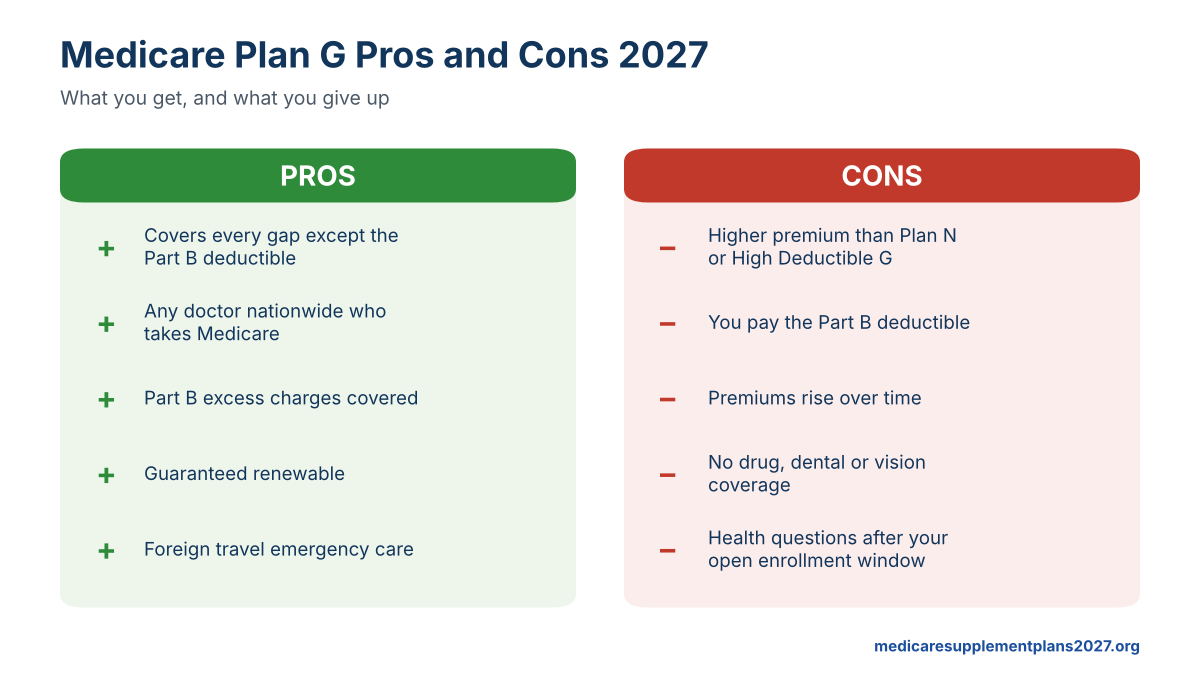
Pros Cons
Covers every Medicare gap except the Part B deductible Higher monthly premium than Plan N or High Deductible G
See any doctor or hospital in the U.S. that accepts Medicare You pay the Part B deductible each year
Covers Part B excess charges Premiums typically rise over time
Guaranteed renewable as long as you pay your premium No prescription drug, dental, vision or hearing coverage
Foreign travel emergency coverage Health questions in most states after your open enrollment window

The Pros of Medicare Plan G

1. The most complete coverage you can buy as a new enrollee. Plan F used to be the top plan, but it closed to anyone who became eligible for Medicare on or after January 1, 2020. Plan G is now the most comprehensive plan most new enrollees can buy. It covers the Part A deductible, Part A and Part B coinsurance, the first three pints of blood, hospice coinsurance and skilled nursing facility coinsurance.

2. Predictable costs. Once you meet the Part B deductible, Plan G covers your Medicare-approved costs for the rest of the year. No copays at the doctor, no coinsurance surprises after a hospital stay. You know roughly what a bad health year will cost you before it happens.

3. No networks and no referrals. Plan G works with any doctor, specialist or hospital in the country that accepts Medicare. You don’t need a referral to see a specialist, and you aren’t locked into a local network the way you are with most Medicare Advantage plans.

4. Part B excess charges are covered. Some doctors don’t accept Medicare’s approved amount as full payment and can charge up to 15% more. Plan G pays those excess charges. Plan N does not.

5. Guaranteed renewable. Your insurance company can’t cancel your Plan G because of your health or how many claims you file, as long as you pay your premium.

6. Foreign travel emergency coverage. Plan G pays 80% of medically necessary emergency care during the first 60 days of a trip outside the U.S., after a $250 deductible, up to a $50,000 lifetime limit.

Compare 2027 Plan G Rates in Your Area

Speak with a licensed insurance agent

1-855-409-6195TTY 711

Mon-Fri: 5am-7pm, Sat-Sun: 7am-4pm CT

The Cons of Medicare Plan G

1. It costs more than Plan N or High Deductible Plan G. You pay for the extra coverage every month, whether you use it or not. See what Plan G costs in 2027 for a full breakdown.

2. You pay the Part B deductible. The Part B deductible is the one gap Plan G leaves open. It was $283 in 2026, and CMS announces the 2027 amount in the fall. Read more on the Plan G deductible for 2027.

3. Premiums go up. Plan G premiums typically rise each year as you age and as companies adjust rates. Some companies raise rates faster than others, which is why rate history matters as much as the starting price. See Plan G rate increases for 2027.

4. No extras. Plan G does not include prescription drug, dental, vision or hearing coverage. You’ll need a separate Part D plan for drugs, and stand-alone dental or vision coverage if you want it.

5. Switching later can be hard. Your Medigap Open Enrollment Period lasts six months, starting the month you’re 65 or older and enrolled in Part B. During that window you can’t be turned down or charged more for health reasons. After it ends, most states let companies ask health questions if you apply for a new plan.

Broker tip: Since every Plan G has identical benefits, never buy one on brand name alone. Compare the premium and the company’s rate increase history side by side.

Average monthly premium for Plan G vs Plan N, High Deductible G and Plan F at age 65

Plan G vs. Plan N, High Deductible G and Plan F

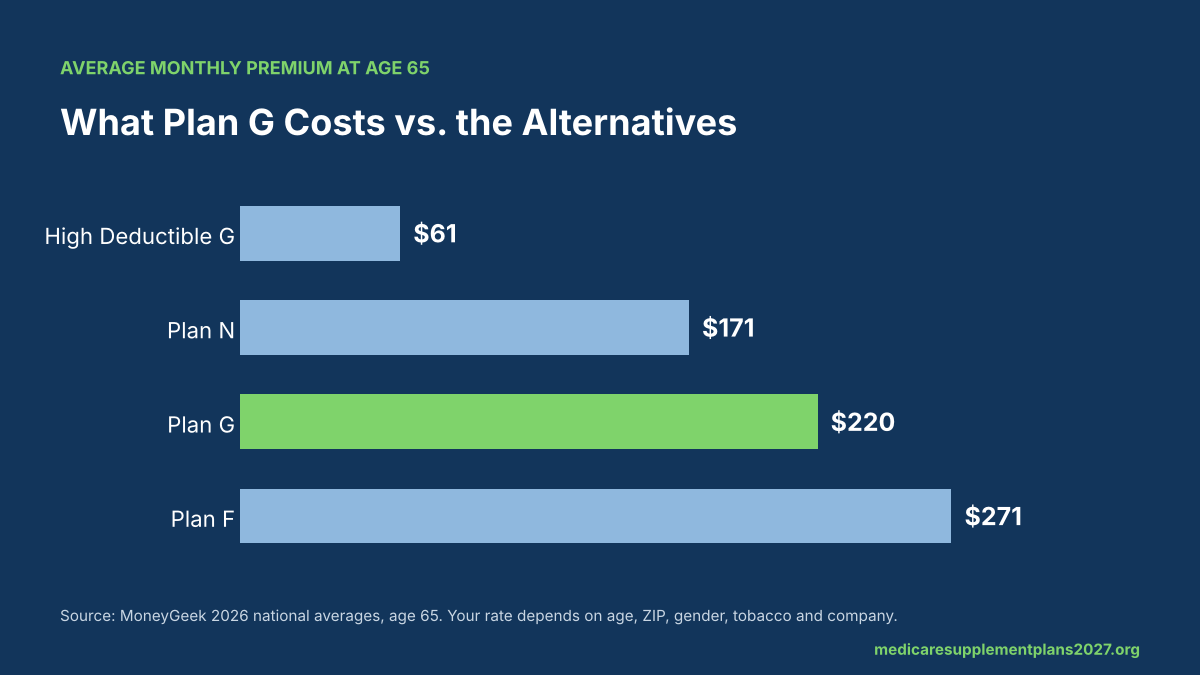
The biggest con of Plan G is price, so it helps to see what the alternatives cost and what you give up with each one. National average premiums at age 65 from MoneyGeek’s 2026 data:

Plan Avg. premium Trade-off vs. Plan G
High Deductible G $61/mo Same benefits, but you pay the first $3,050 in 2027
Plan N $171/mo Copays up to $20 at the doctor and $50 at the ER, no excess charge coverage
Plan G $220/mo You pay only the Part B deductible
Plan F $271/mo Also covers the Part B deductible, but only for people eligible before 2020

Your actual rate depends on your age, ZIP code, gender, tobacco use and the insurance company. Compare them side by side in Plan G vs. Plan N 2027, High Deductible Plan G 2027 and Plan F 2027.

Who Should Choose Plan G?

Plan G is usually the right call if you:

  • Want predictable costs and no copays after the Part B deductible
  • See doctors regularly or manage an ongoing condition
  • Travel or split time between states and want any Medicare provider nationwide
  • Are in your open enrollment window and want the most coverage you can lock in without health questions

Look at Plan N or High Deductible G instead if you:

  • Are healthy, rarely see the doctor and want the lowest premium
  • Don’t mind small copays in exchange for a lower monthly bill (Plan N)
  • Have savings to cover a $3,050 deductible in a bad year (High Deductible G)

If you’re weighing Plan G against a Medicare Advantage plan instead, see Medicare Supplement vs. Medicare Advantage 2027.

Compare 2027 Medicare Supplement Rates & Benefits

Speak with a licensed insurance agent

1-855-409-6195TTY 711

Mon-Fri: 5am-7pm, Sat-Sun: 7am-4pm CT

Medicare Plan G Pros and Cons FAQs

➤ Is Medicare Plan G worth it in 2027?

For most people new to Medicare, yes. Plan G covers every Medicare gap except the Part B deductible, so after you pay that once a year your Medicare-approved costs are covered. It costs more per month than Plan N or High Deductible Plan G, so it is worth it if you value predictable costs over the lowest premium.

➤ What is the biggest disadvantage of Plan G?

The premium. Plan G costs more each month than Plan N or High Deductible Plan G, and premiums typically rise over time as you age and as the company adjusts rates. You also pay the Part B deductible yourself.

➤ Does Plan G cover the Part B deductible?

No. The Part B deductible is the one gap Plan G does not cover. It was $283 in 2026. CMS announces the 2027 amount in the fall. Once you meet it, Plan G covers your Medicare-approved Part B costs for the rest of the year.

➤ Does Plan G cover prescription drugs?

No. Medicare Supplement plans do not include prescription drug coverage. Most people pair Plan G with a stand-alone Medicare Part D plan.

➤ Can I switch from Plan G to another plan later?

You can apply to change Medigap plans at any time, but outside your Medigap Open Enrollment Period most states let insurance companies ask health questions and decline you or charge more. A few states have rules that give you guaranteed rights to switch.

➤ Is Plan G better than Plan N?

Plan G covers more. Plan N has a lower premium but adds copays of up to $20 for some office visits and up to $50 for ER visits that do not lead to admission, and it does not cover Part B excess charges. Plan G is better if you want no copays; Plan N is better if you want to save on premiums and rarely see the doctor.

➤ Does Plan G cover medical care outside the United States?

Yes, for emergencies. Plan G pays 80% of medically necessary emergency care during the first 60 days of a trip outside the U.S., after a $250 deductible, up to a $50,000 lifetime limit.

New to Medicare?

If you are new to Medicare, then you can enroll in a 2027 Medicare Supplement plan up to six months prior to your Medicare Part B effective date.

Call one of our licensed insurance agents to see what the best time frame is for you to enroll, based on your current situation. You can contact them at 1-855-409-6195.

Have Questions?

Speak with a licensed insurance agent

1-855-409-6195

Compare plans & benefits in your area

Or speak with a licensed insurance agent

1-855-409-6195TTY 711

Mon-Fri: 5am-7pm, Sat-Sun: 7am-4pm CT