





Speak with a licensed insurance agent

1-855-409-6195

TTY users 711 Mon-Fri: 5am-7pm, Sat-Sun: 7am-4pm CT
Advertisement

Are Medicare Supplement Premiums Tax Deductible in 2027? IRS Rules, the 7.5% Floor and a Worked Example

Reviewed by Russell Noga, Licensed Medicare Insurance Broker (all 50 states) — Last updated November 7, 2026

Yes, Medicare Supplement premiums are tax deductible as a medical expense, but only if you itemize on Schedule A and only for the part of your total medical costs above 7.5% of your adjusted gross income. Self-employed people who meet the IRS rules can instead deduct them above the line on Form 7206, with no 7.5% floor and no need to itemize.

2027 by the Numbers

7.5%

of AGI that medical costs must pass before any of it counts (IRS Publication 502)

$18,150

2026 standard deduction for a single filer 65 or older (IRS Rev. Proc. 2025-32)

$6,000

extra deduction per person 65+ for tax years 2025 to 2028, itemizing or not (IRS)

The IRS treats a Medicare Supplement policy like other health insurance you buy yourself. The premium joins your Part B premium, drug plan premium and dental bills in one medical total. Whether that total lowers your tax depends on your income and whether you itemize.

Below are the three places the premium can land on a return, the 7.5% math with example numbers, and how the newer senior deduction fits in. For pre-tax prices, see our guide to Medicare Supplement plans cost. This is general information, not tax advice. Check your own situation with a tax professional.

Compare 2027 Medicare Supplement Premiums in Your ZIP Code

Speak with a licensed insurance agent

1-855-409-6195TTY 711

Mon-Fri: 5am-7pm, Sat-Sun: 7am-4pm CT

Licensed insurance agent

Three Places a Medicare Supplement Premium Can Land on Your Tax Return

Are Medicare Supplement premiums tax deductible: three IRS routes compared

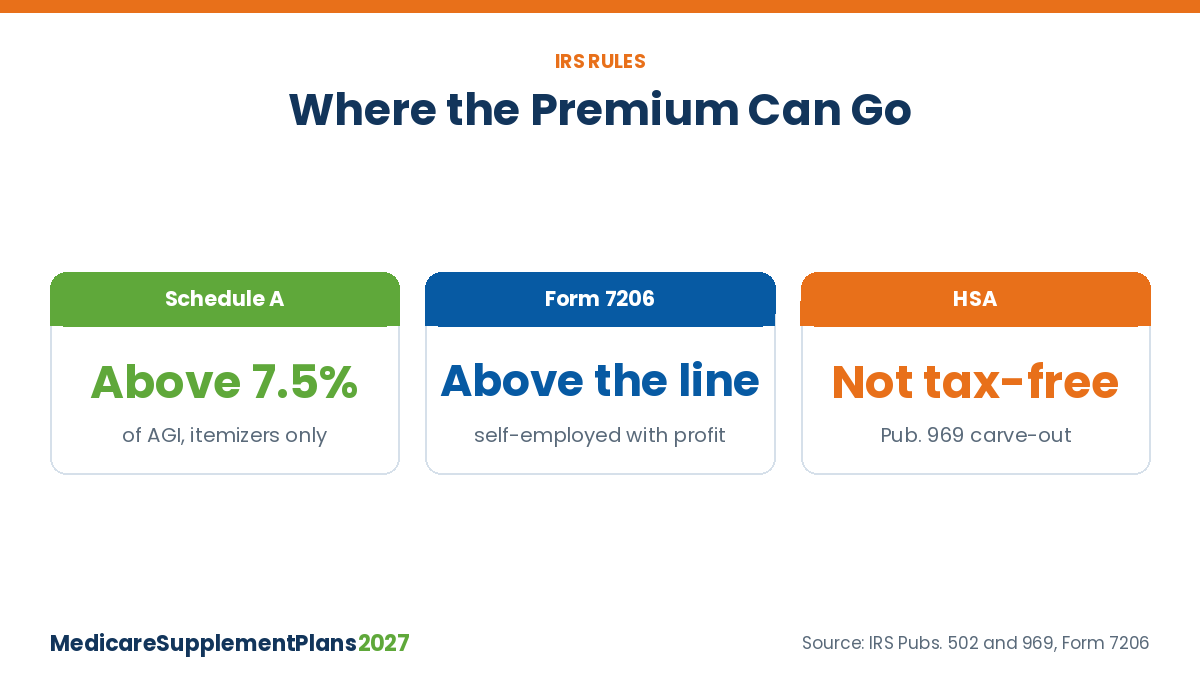
There is no Medicare Supplement line on Form 1040. The premium falls under one of three rules, depending on your work status and how you paid.

Route Who can use it Limit Where it goes
Itemized medical deduction Anyone who itemizes Only medical costs above 7.5% of AGI Schedule A (Form 1040)
Self-employed health insurance deduction People with a business net profit who are not eligible for an employer-subsidized plan, including a spouse’s Tied to the business’s earnings Form 7206, then Schedule 1
Health savings account HSA owners Medicare Supplement premiums are not a qualified expense Not a tax-free use

Sources: IRS Publication 502, Instructions for Form 7206 (2025), IRS Publication 969.

No double dipping: IRS Publication 502 bars counting a premium on Schedule A if you already used it for a credit or another deduction.

Medicare Supplement Quotes

Call a Licensed Agent Now

Compare 2027 Plan G, Plan N and more from several insurance companies in one call.

☎ 1-855-409-6195

Advertisement

TTY users 711  |  Mon–Fri: 5am–7pm, Sat–Sun: 7am–4pm CT

No obligation to enroll

Self-Employed in Retirement: The Above-the-Line Option

For people still earning business income after joining Medicare, Form 7206 is usually worth more, because it lowers adjusted gross income directly with no floor.

1

Confirm a net profit. The Form 7206 instructions require net profit on Schedule C or F, or qualifying partner or S corporation income. A business that lost money does not qualify.

2

Check each month for employer coverage. No deduction for any month you were eligible for an employer-subsidized plan, including through a spouse’s job, even if you declined it.

3

Add up Medicare premiums. The instructions allow Medicare premiums you voluntarily pay for insurance in your name. Insurer guides commonly list Part B, Part D and Medicare Supplement premiums.

4

Move leftovers to Schedule A. Publication 502 says premiums that do not fit here can join your other medical costs on Schedule A, still subject to the 7.5% floor.

This deduction cuts income tax only, not self-employment tax.

The 7.5% Floor, Worked Out With Example Numbers

For everyone else, medical spending must clear 7.5% of AGI, and then all itemized deductions together must beat the standard deduction. Two example retirees show how differently that can turn out.

Example only (not a quote) Retiree A Retiree B
Filing status and age Single, 70 Single, 70
Adjusted gross income $40,000 $40,000
Medicare Supplement premium for the year $2,400 $2,400
Part B premium (2026 standard, 12 x $202.90) $2,434.80 $2,434.80
Part D premium $480 $480
Dental, hearing aids and other out-of-pocket costs $1,000 $15,000
Total medical costs $6,314.80 $20,314.80
Minus 7.5% of AGI ($3,000) $3,314.80 $17,314.80
Plus state taxes and gifts to charity $4,000 $4,000
Total itemized vs. $18,150 standard deduction $7,314.80: take the standard deduction $21,314.80: itemizing wins by $3,164.80

Round illustrative numbers. Plan G premiums vary by ZIP code, age, sex and tobacco use. The $6,000 senior deduction applies to both people either way.

Retiree A paid the same Medicare Supplement premium but got no tax benefit. A large one-time cost, such as dental implants, is what usually pushes a retiree over the line. With a lower-premium plan like high-deductible Plan G, more spending shifts to out-of-pocket costs, which count toward the same total.

Standard Deduction vs. Itemizing After the New Senior Deduction

Standard deduction vs itemizing when Medicare Supplement premiums are tax deductible

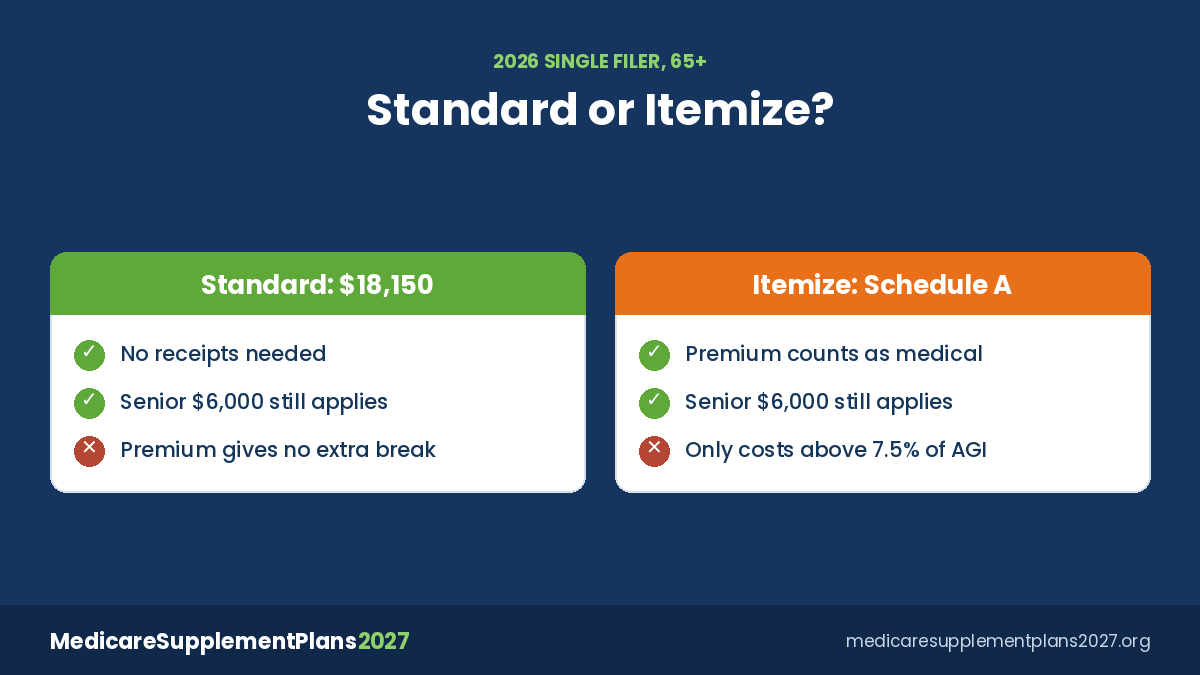
People 65 and older already get a larger standard deduction. Recent federal tax law also added a separate deduction of up to $6,000 per person 65 or older for tax years 2025 through 2028.

2026 federal figure Single, 65+ Married filing jointly, both 65+
Base standard deduction $16,100 $32,200
Extra amount for age 65 $2,050 $1,650 each ($3,300)
Standard deduction total $18,150 $35,500
Senior deduction (separate, itemizers too) Up to $6,000 Up to $12,000

Sources: IRS Rev. Proc. 2025-32 and IRS senior deduction guidance. The senior deduction phases out above $75,000 of modified AGI ($150,000 joint), needs a Social Security number for each person and requires married couples to file jointly. The IRS sets 2027 amounts separately.

Because the senior deduction applies whether or not you itemize, it does not tip the choice. The real test is still whether Schedule A beats $18,150 or $35,500. People under 65 on Medicare because of a disability do not get the age-based amounts; see Medicare Supplement plans for people under 65.

Compare plans & benefits in your area

Or speak with a licensed insurance agent

1-855-409-6195TTY 711

Mon-Fri: 5am-7pm, Sat-Sun: 7am-4pm CT

Licensed insurance agent

Why an HSA Cannot Pay Your Medicare Supplement Premium Tax-Free

Many new retirees reach Medicare with money left in a health savings account. IRS Publication 969 lets people 65 and older use it for Medicare and other health coverage premiums, except premiums for a Medicare supplemental policy, such as Medigap.

Not a qualified expense. An HSA withdrawal for a Medicare Supplement premium is taxable income. After 65 the extra HSA penalty no longer applies, but income tax does.

Other Medicare bills can qualify. For an owner 65 or older, Part B and Part D premiums qualify, as do the deductibles and coinsurance a Medicare Supplement plan leaves to you.

One tax break per dollar. HSA-paid costs cannot also go on Schedule A. One option: HSA dollars for Part B and out-of-pocket costs, regular money for the Medicare Supplement premium.

Spouse rule: Under Publication 969, if the HSA owner is under 65, Medicare premiums for a spouse 65 or older generally do not qualify.

Records, Timing and State Income Taxes

Count what you paid that year. Medical expenses count in the tax year you paid them, so total the premiums actually paid from January to December.

Find Part B on your SSA-1099. If Part B comes out of your Social Security check, the yearly Form SSA-1099 shows the Medicare premiums withheld. That amount counts as paid by you.

Keep insurer statements. Your Medicare Supplement company can provide a yearly premium history. Keep it with bank records.

Check your state separately. Some states have no personal income tax, and others use their own deductions or medical expense limits.

When comparing plans, start with the pre-tax premium: see the cheapest Medicare Supplement plans and our Plan G cost guide. CMS set the 2027 Part B premium at $209.40 a month.

Bottom Line

Medicare Supplement premiums are deductible, but for most retirees that only helps when big medical bills push Schedule A past the 7.5% floor and above the standard deduction. Self-employed people with a profit have a stronger route, and an HSA cannot pay the premium tax-free. This is general information, not tax advice; confirm your numbers with a tax professional.

See 2027 Medicare Supplement rates near you

Speak with a licensed insurance agent

1-855-409-6195TTY 711

Mon-Fri: 5am-7pm, Sat-Sun: 7am-4pm CT

Licensed insurance agent

Medicare Supplement Premiums and Taxes — Frequently Asked Questions

➤ Can I deduct my Medicare Supplement premium if I take the standard deduction?

No. The medical expense deduction is itemized on Schedule A, so the standard deduction leaves the premium without a separate break. The self-employed deduction on Form 7206 is the exception.

➤ Does the $6,000 senior deduction replace the medical expense deduction?

No. It is a separate deduction for people 65 and older for tax years 2025 through 2028, open to itemizers and non-itemizers. It phases out above $75,000 of modified AGI, or $150,000 joint.

➤ Can I pay my Medicare Supplement premium from my HSA?

You can withdraw the money, but IRS Publication 969 excludes Medicare supplemental policy premiums, so the withdrawal is taxable. Part B and Part D premiums can be paid tax-free once the owner is 65.

➤ Can a married couple combine both Medicare Supplement premiums?

Yes. On a joint return, both spouses’ medical costs go into one total, measured against your combined adjusted gross income.

➤ I do part-time consulting after retiring. Can I use the self-employed deduction?

Possibly, if the work shows a net profit and you were not eligible for an employer-subsidized plan, including a spouse’s, in those months. It goes on Form 7206 and does not cut self-employment tax.

➤ Where do I find how much Part B was taken from my Social Security?

Your yearly Form SSA-1099 shows the Medicare premiums withheld from benefits. Add that to your other premiums when totaling medical costs.

➤ Does paying my premium annually instead of monthly change the deduction?

Medical expenses count in the year paid, so the calendar-year total is what matters, not the billing mode.

➤ Do states let me deduct Medicare Supplement premiums?

It depends on the state. Some have no personal income tax and others set their own rules, so check your state revenue department or a tax professional.

New to Medicare?

If you are new to Medicare, then you can enroll in a 2027 Medicare Supplement plan up to six months prior to your Medicare Part B effective date.

Call one of our licensed insurance agents to see what the best time frame is for you to enroll, based on your current situation. You can contact them at 1-855-409-6195.

Medicare Supplement Quotes

Call a Licensed Agent Now

Compare 2027 Plan G, Plan N and more from several insurance companies in one call.

☎ 1-855-409-6195

Advertisement

TTY users 711  |  Mon–Fri: 5am–7pm, Sat–Sun: 7am–4pm CT

No obligation to enroll

Compare plans & benefits in your area

Or speak with a licensed insurance agent

1-855-409-6195TTY 711

Mon-Fri: 5am-7pm, Sat-Sun: 7am-4pm CT

Licensed insurance agent