





Speak with a licensed insurance agent

1-855-409-6195

TTY users 711 Mon-Fri: 5am-7pm, Sat-Sun: 7am-4pm CT
Advertisement

Medicare Part B Excess Charges 2027: The 15% Rule, the Real Math and Which Plans Pay

Reviewed by Russell Noga, Licensed Medicare Insurance Broker (all 50 states) — Last updated November 3, 2026

Medicare Part B excess charges are the extra amount, up to 15% above the Medicare-approved amount, that a doctor who does not accept Medicare assignment can bill you. Medicare and most supplement plans never pay that extra; Medicare Supplement Plan G and Plan F pay it in full, while Plan N leaves it to you.

2027 by the Numbers

15%

most a non-assigned provider may bill above the approved amount (Medicare.gov)

95%

of the full fee schedule Medicare approves for non-participating providers (CMS fee schedule)

$283

2026 Part B deductible; $292 for 2027 (Medicare Trustees)

Most people on Original Medicare never see an excess charge, because the large majority of doctors accept assignment. The trouble shows up with the occasional specialist, surgeon or out-of-state clinic that bills Medicare on its own terms. When that happens, the gap lands on you unless your supplement plan covers it.

This guide walks through how the charge is figured, what it looks like in real dollars, which plans pay it for 2027, the states that restrict it, and how the risk should shape the choice between Plan G and Plan N.

Compare 2027 Plan G and Plan N Rates

Speak with a licensed insurance agent

1-855-409-6195TTY 711

Mon-Fri: 5am-7pm, Sat-Sun: 7am-4pm CT

Licensed insurance agent

How an Excess Charge Ends Up on a Medicare Bill

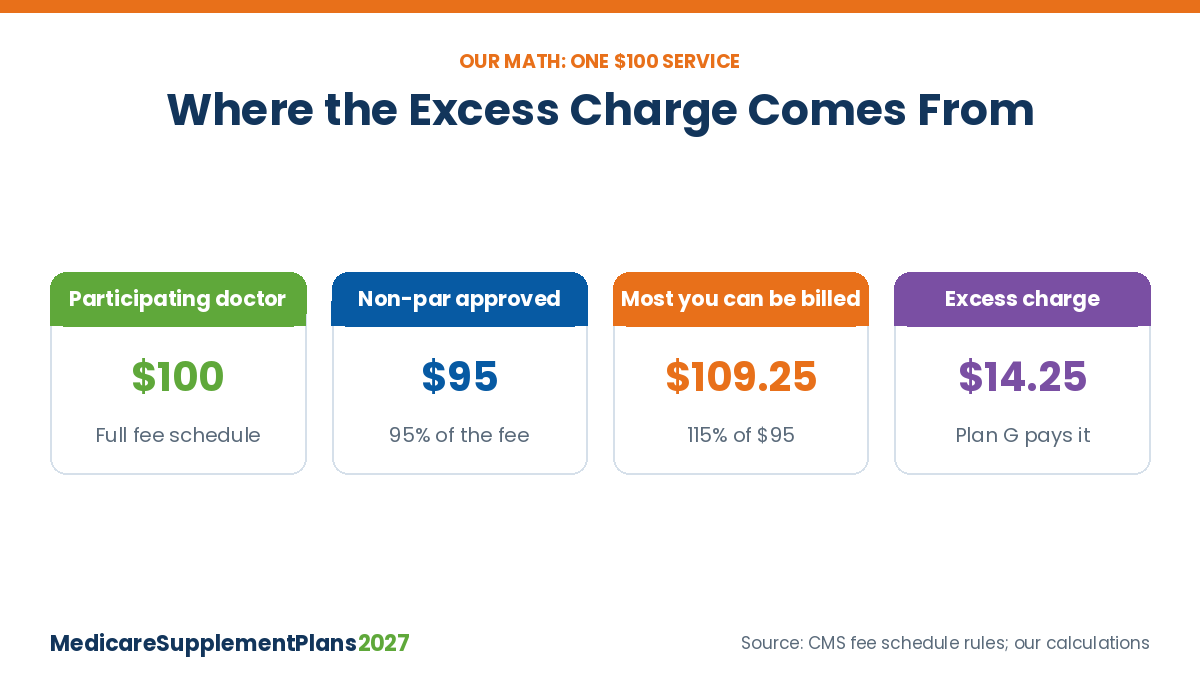
Medicare Part B excess charges explained: on a $100 service a non-participating doctor is approved $95 and may bill up to $109.25, an excess charge of $14.25

Every doctor and practitioner who treats Original Medicare patients falls into one of three groups. Which group your doctor is in decides whether an excess charge is even possible.

Participating (accepts assignment). Takes the Medicare-approved amount as full payment for all covered services. You owe only your deductible and coinsurance, and the office files the claim. No excess charge is allowed.

Non-participating. Enrolled in Medicare but decides claim by claim whether to accept assignment. On a claim where it does not, it may bill up to the limiting charge, and you may be asked to pay the full bill at the visit.

Opted out. Has left Medicare for at least two years and works under a private contract. Medicare pays nothing except in emergencies, and no supplement plan pays either, so this is not an excess-charge situation at all.

The excess charge is only the slice between the Medicare-approved amount and the most the non-participating provider may bill. Your regular 20% Part B coinsurance and the Part B deductible are separate costs that every plan handles in its own way.

Medicare Supplement Quotes

Call a Licensed Agent Now

Compare 2027 Plan G, Plan N and more from several insurance companies in one call.

☎ 1-855-409-6195

Advertisement

TTY users 711  |  Mon–Fri: 5am–7pm, Sat–Sun: 7am–4pm CT

No obligation to enroll

The Limiting Charge Formula, Worked in Dollars

Two numbers drive the math. Medicare approves only 95% of its normal fee schedule for a non-participating provider. That provider may then bill up to 115% of that reduced amount, which is called the limiting charge. So the most you can be billed works out to about 109.25% of what a participating doctor would be paid, and the excess charge itself is about 14.25% of the full fee schedule amount.

Full fee schedule amount Approved for non-par (95%) Most you can be billed (limiting charge) Excess charge Medicare pays (80% of approved)
$100 $95.00 $109.25 $14.25 $76.00
$250 $237.50 $273.13 $35.63 $190.00
$500 $475.00 $546.25 $71.25 $380.00
$1,000 $950.00 $1,092.50 $142.50 $760.00
$2,500 $2,375.00 $2,731.25 $356.25 $1,900.00
$5,000 $4,750.00 $5,462.50 $712.50 $3,800.00

Our math, using the CMS rules: non-par approved amount = 95% of the fee schedule; limiting charge = 115% of that amount. Sample amounts are illustrations, not real fees. Assumes the Part B deductible is already met.

Notice what the table shows. Most guides say a doctor can charge 15% more, which is true of the approved amount the claim uses. Measured against what a participating doctor would get for the same service, the bill is only about 9.25% higher, because the non-participating fee starts 5% lower. On a large surgery bill, though, that slice can still run into hundreds of dollars.

Which Medicare Supplement Plans Pay Excess Charges in 2027

Supplement plan benefits are set by federal law, so the answer is the same at every insurance company. Only two plan letters include the excess-charge benefit, plus their high-deductible versions.

Plan Pays Part B excess charges? Notes for 2027
Plan G Yes, 100% Open to anyone new to Medicare
Plan F Yes, 100% Only for people eligible for Medicare before January 1, 2020
High-deductible G or F Yes, after the $3,050 deductible Costs before the deductible is met are yours
Plan N No You also pay up to $20 per office visit and up to $50 per ER visit
Plans A, B, C, D, K, L, M No Excess charges also do not count toward the K and L out-of-pocket limits

Sources: Medicare.gov standardized plan chart; CMS 2027 high-deductible amount.

Billing fact: An excess charge only exists on a claim where the provider does not accept assignment. A participating doctor cannot add one, no matter which plan letter you carry, and an opted-out doctor falls outside Medicare and every supplement plan.

Plan G is the plan most new enrollees pick when they want this protection; the 2027 Plan G guide covers its other benefits. Anyone who still holds Plan F already has the same excess-charge coverage.

Plan G or Plan N: Putting a Price on the Excess-Charge Risk

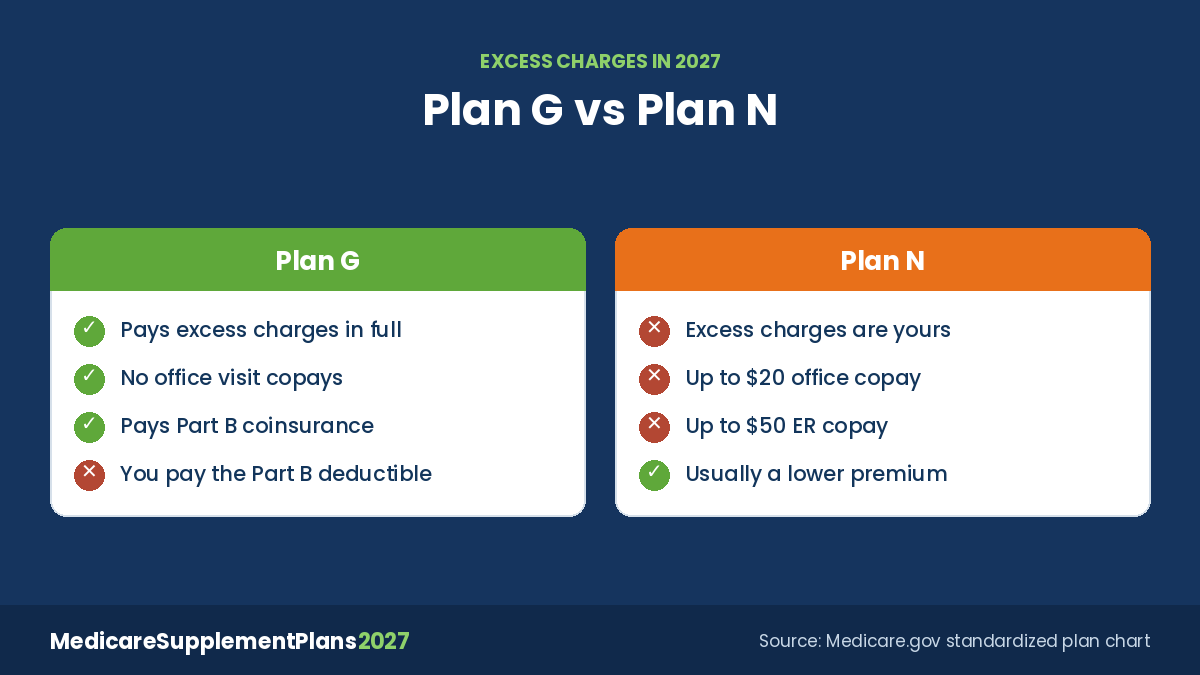
Medicare Part B excess charges under Plan G vs Plan N in 2027: Plan G pays them in full, Plan N leaves them to you

For many shoppers the excess-charge benefit is the deciding point between Plan G and Plan N. Plan N usually costs less each month, but it leaves you open to excess charges plus small copays. The useful question is how big that exposure could get in a bad year.

Non-assigned care in one year (approved amounts) Excess charges you would owe on Plan N Owed on Plan G
$1,000 $150 $0
$5,000 $750 $0
$10,000 $1,500 $0
$25,000 $3,750 $0

Our math: excess charge = 15% of the non-participating approved amount, assuming every claim is billed at the full limiting charge. Plan N copays not included.

Compare those figures with the yearly premium gap on your own quotes. If Plan G costs a few hundred dollars more per year, one surgery with a non-assigned surgeon could erase the Plan N savings. If every doctor you use accepts assignment and you rarely travel, the risk is small. Our 2027 comparison chart lines up every other benefit the two plans share.

Compare plans & benefits in your area

Or speak with a licensed insurance agent

1-855-409-6195TTY 711

Mon-Fri: 5am-7pm, Sat-Sun: 7am-4pm CT

Licensed insurance agent

States That Ban or Limit Excess Charges

A handful of states go further than federal law and restrict what non-assigned providers in the state may bill. Published guides commonly list eight states. The rules differ, so treat this as a starting point and confirm with your State Health Insurance Assistance Program (SHIP) or state insurance department.

State What is commonly reported
Connecticut Protection reported for some residents only, tied to income or program enrollment; others can still be billed
Massachusetts Excess charges barred for most care from in-state doctors
Minnesota Barred for most services for residents; ambulance and medical equipment reported as exceptions
New York Capped at 5% above the approved amount for most services; some office and home visits fall back to the federal 15% cap
Ohio Listed as prohibiting excess charges
Pennsylvania State Medicare fee law makes it illegal to charge above the Medicare-approved amount
Rhode Island Listed as prohibiting excess charges
Vermont Listed as prohibiting excess charges

Compiled from published consumer guides and state law summaries; details and exceptions vary. Confirm current rules with your state before relying on them.

Two limits apply everywhere. The protection covers care from providers in that state, so a visit to a specialist across the border can still carry an excess charge. And a state ban does not change your supplement plan: Plan N in Pennsylvania still lacks the benefit, but there is less for it to miss.

How to Check Whether a Doctor Accepts Assignment

1

Search Medicare Care Compare. The official Care Compare tool on Medicare.gov shows whether a doctor or clinic participates in Medicare and accepts assignment.

2

Ask the office directly. Ask whether the doctor accepts Medicare assignment for all services, not only whether they take Medicare. A non-participating office can say yes to the second question.

3

Check the opt-out list. CMS publishes an opt-out affidavit lookup on data.cms.gov. If your doctor is listed, Medicare and your supplement plan will not pay, so ask about costs before any care.

4

Read your Medicare Summary Notice. Each notice shows the approved amount and what the provider may bill you. A bill above the limiting charge is not allowed, and you can question it.

Before the appointment: A non-participating provider may ask for full payment at the visit. Medicare then repays its share to you, and Plan G or Plan F repays the excess charge and coinsurance once the claim is processed.

Bottom Line

Part B excess charges are rare but not small: on a $5,000 service they can top $700. Plan G and Plan F pay them in full, high-deductible G and F pay them after the deductible, and Plan N does not. If your doctors all accept assignment or you live in a state that bans the charge, Plan N’s lower premium may be worth it; otherwise Plan G removes the risk.

See 2027 plans that pay excess charges in your ZIP code

Speak with a licensed insurance agent

1-855-409-6195TTY 711

Mon-Fri: 5am-7pm, Sat-Sun: 7am-4pm CT

Licensed insurance agent

Medicare Part B Excess Charges — Frequently Asked Questions

➤ What is the most a doctor can charge above the Medicare-approved amount?

A non-participating provider may bill up to 15% above the Medicare-approved amount for that claim, called the limiting charge. Because the approved amount for non-participating providers is 95% of the normal fee, the total is about 9.25% above what a participating doctor receives.

➤ Does Medicare pay any part of an excess charge?

No. Medicare pays 80% of the approved amount after the Part B deductible, and the excess charge sits above that approved amount. Only Plan G, Plan F and their high-deductible versions pick it up.

➤ Does Plan N ever cover excess charges?

No. Plan N pays the Part B coinsurance apart from its office and emergency copays, but it has no excess-charge benefit in any state.

➤ Do excess charges apply to hospital stays?

Excess charges are a Part B rule, so they apply to doctor and other outpatient bills, including surgeons and specialists who see you in the hospital. The hospital’s own Part A bill does not carry them.

➤ Is an excess charge the same as the Part B deductible?

No. The Part B deductible is $283 for 2026, with $292 for 2027, and you owe it before Part B pays. An excess charge is an added amount on a single claim from a non-assigned provider.

➤ What happens if a doctor bills more than the limiting charge?

Billing above the limiting charge is not allowed. Compare the bill with your Medicare Summary Notice, ask the office to correct it, and contact Medicare or your state SHIP if it is not fixed.

➤ Will my state ban protect me when I travel?

Generally not. State limits apply to providers in that state, so care from a non-assigned doctor in another state can still include the full federal 15% excess charge.

➤ Do excess charges count toward the high-deductible Plan G amount?

Costs the plan would normally pay generally count toward the $3,050 deductible, and Plan G normally pays excess charges. Check the outline of coverage from the company before you buy to confirm.

New to Medicare?

If you are new to Medicare, then you can enroll in a 2027 Medicare Supplement plan up to six months prior to your Medicare Part B effective date.

Call one of our licensed insurance agents to see what the best time frame is for you to enroll, based on your current situation. You can contact them at 1-855-409-6195.

Medicare Supplement Quotes

Call a Licensed Agent Now

Compare 2027 Plan G, Plan N and more from several insurance companies in one call.

☎ 1-855-409-6195

Advertisement

TTY users 711  |  Mon–Fri: 5am–7pm, Sat–Sun: 7am–4pm CT

No obligation to enroll

Compare plans & benefits in your area

Or speak with a licensed insurance agent

1-855-409-6195TTY 711

Mon-Fri: 5am-7pm, Sat-Sun: 7am-4pm CT

Licensed insurance agent