





Speak with a licensed insurance agent

1-855-409-6195

TTY users 711 Mon-Fri: 5am-7pm, Sat-Sun: 7am-4pm CT
Advertisement

Does Medicare Supplement Cover Hearing Aids in 2027? Exams, Implants, Discounts and Real Prices

Reviewed by Russell Noga, Licensed Medicare Insurance Broker (all 50 states) — Last updated November 10, 2026

No, a Medicare Supplement plan does not pay for hearing aids or the exams used to fit them, because federal law excludes both from Original Medicare and a Supplement only pays its share of Medicare-approved care. It does pay its share of Part B diagnostic hearing and balance exams and of cochlear and bone-anchored implants, which Medicare treats as prosthetic devices rather than hearing aids.

2027 by the Numbers

20%

Part B coinsurance on a covered diagnostic hearing exam, which Plans G, F, C and D pay in full (Medicare.gov)

$2,694

average price paid for a pair of hearing aids in a 2026 survey of 1,100+ buyers (HearingTracker)

32 states

had Medicaid hearing aid coverage for adults at the end of 2023 (Health Affairs study)

Hearing aids sit on the short list of things Congress wrote out of Medicare when the program began, next to eyeglasses and routine dental work. Because every Supplement plan letter is built to fill gaps in Medicare-approved claims, a hearing aid bill never reaches the policy. The exam that diagnoses hearing loss is a different story, and so is a surgically implanted device.

This page sorts hearing care into what is covered, what is not and what your Supplement adds, then looks at real prices, the hearing discounts some carriers attach to their policies, and the outside programs that do buy hearing aids. The dental version of this question has a different set of exceptions; see does Medicare Supplement cover dental.

Compare 2027 Medicare Supplement Rates in Your Area

Speak with a licensed insurance agent

1-855-409-6195TTY 711

Mon-Fri: 5am-7pm, Sat-Sun: 7am-4pm CT

Licensed insurance agent

Hearing Care Sorted: Covered, Not Covered and Your Supplement's Share

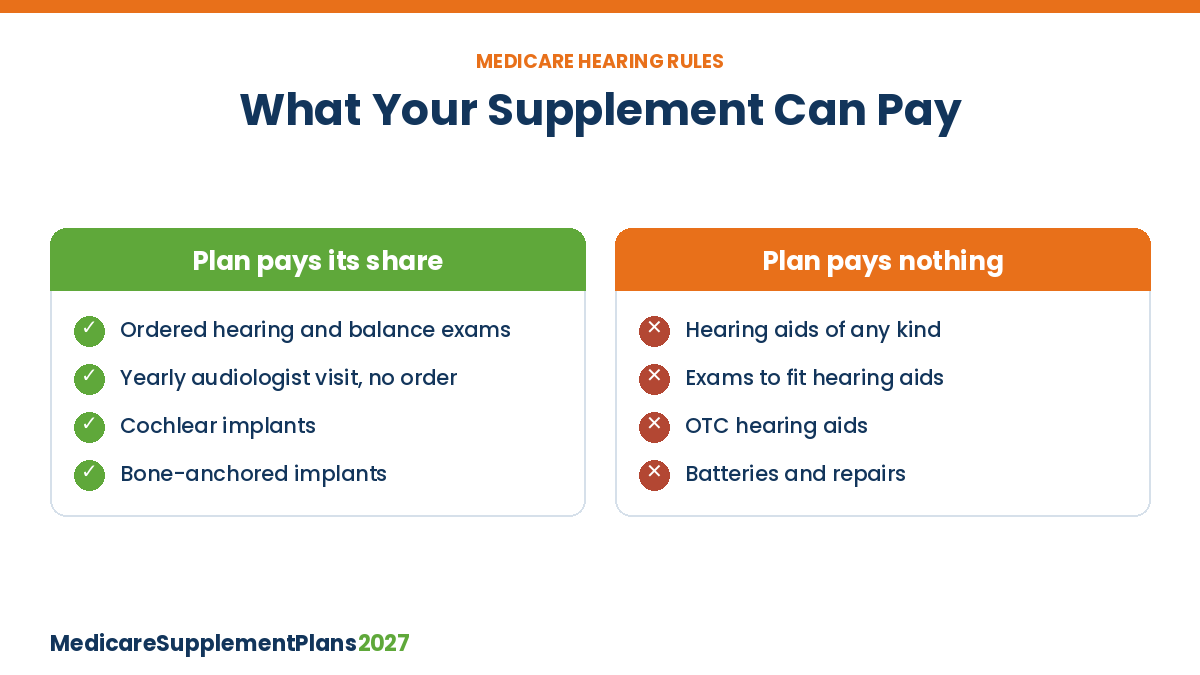
Does Medicare Supplement cover hearing aids: diagnostic exams and implants covered, hearing aids and fittings not covered

The dividing line is purpose. Medicare pays to find out what is wrong with your ears and to replace a part of the hearing system that no longer works. It does not pay to amplify sound with a worn device. The table lines up each common service with the Part B rule and what a Supplement then pays.

Hearing service Original Medicare rule What a Supplement pays
Diagnostic hearing and balance exam ordered by your doctor Part B covers it; you owe 20% after the Part B deductible Its plan-letter share of the 20%; Plan G covers all of it once the deductible is met
Audiologist visit without a doctor’s order Covered once every 12 months for gradual, non-acute hearing loss Same share as any Part B service
Hearing aid exam, fitting or adjustment Excluded by law Nothing
Hearing aids, air or bone conduction Excluded by law Nothing
Cochlear or auditory brainstem implant Covered as a prosthetic device when coverage criteria are met Its share of Part B coinsurance, or the Part A deductible if surgery is inpatient
Bone-anchored (osseointegrated) implant Covered as a prosthetic device, not a hearing aid Its share of the approved claim
Over-the-counter hearing aids Not covered Nothing

Sources: Medicare.gov hearing and balance exams page; 42 CFR 411.15(d); CMS national coverage determination 50.3. Plan N may leave up to a $20 office copay; Plans K and L pay 50% and 75%.

For the full list of Part A and Part B gaps the most popular plan letter fills, see what Medicare Plan G covers.

Medicare Supplement Quotes

Call a Licensed Agent Now

Compare 2027 Plan G, Plan N and more from several insurance companies in one call.

☎ 1-855-409-6195

Advertisement

TTY users 711  |  Mon–Fri: 5am–7pm, Sat–Sun: 7am–4pm CT

No obligation to enroll

The Two-Line Federal Rule Behind the Exclusion

Section 1862(a)(7) of the Social Security Act bars Medicare payment for hearing aids and for examinations to prescribe, fit or change them. CMS spells out the scope in 42 CFR 411.15(d), and the wording explains why some devices that look like hearing aids are still paid for.

Air conduction aids are out. Any device that sends amplified sound to the eardrum falls under the exclusion, from basic models to premium rechargeable pairs.

Worn bone conduction aids are out too. Devices that vibrate through the scalp or touch the middle ear bones are also treated as hearing aids.

Implants that replace a function are in. The rule carves out osseointegrated implants in the skull bone, cochlear implants and auditory brainstem implants, because they take over for the middle ear, cochlea or auditory nerve.

Since a Supplement can only follow Medicare’s decision, a carrier has no way to add hearing aids to a standardized plan letter. The benefits of Plans A through N are set by federal law and are identical from one company to the next.

Getting a Covered Hearing Test, With or Without a Referral

Part B pays for diagnostic hearing and balance exams when a doctor or other provider orders them to decide whether you need medical treatment. Starting in 2023, CMS also let audiologists see patients directly, with no order, for a limited set of tests.

1

Decide which route fits. Sudden hearing loss, ear pain, dizziness or a fall calls for your doctor first. Slow, age-related hearing loss can go straight to an audiologist.

2

Use the direct visit once a year. Medicare allows the no-order audiology visit once every 12 months for non-acute hearing loss and for testing tied to surgically implanted hearing devices. The audiologist bills it with an AB modifier.

3

Confirm the audiologist takes Medicare. A provider who is not enrolled in Medicare cannot send a claim, so the Supplement never pays.

4

Expect the fitting to be billed separately. If the test leads to a hearing aid, the later fitting and device are private-pay, even at the same office.

Billing point: A hearing test billed as a hearing aid evaluation falls under the exclusion, while the same type of test billed as a diagnostic exam can be covered. Asking the office how the visit will be coded before the appointment avoids a surprise bill that the Supplement cannot pay.

What Hearing Aids Cost When No Plan Pays

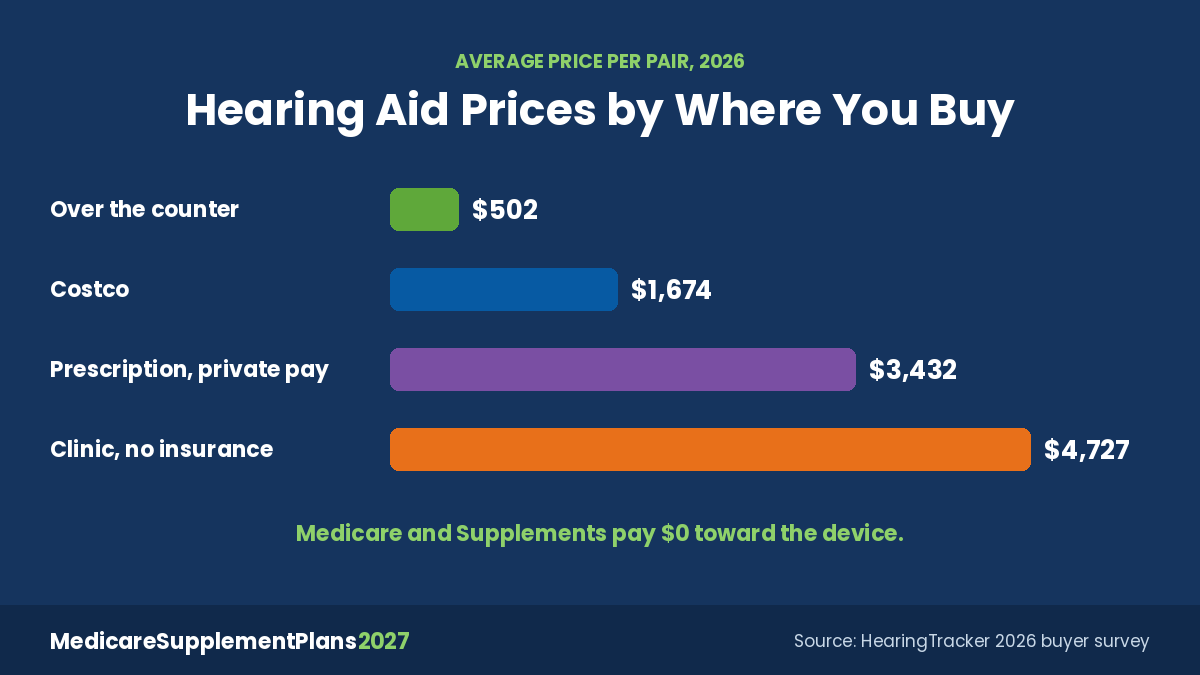
Does Medicare Supplement cover hearing aids: average 2026 hearing aid prices per pair by where you buy them

Because the device is private-pay, where you buy matters more than which plan letter you hold. HearingTracker’s 2026 survey of more than 1,100 buyers found an average of $2,694 per pair, with wide gaps by channel.

Where purchased Average price per pair What usually comes with it
Over the counter $502 Self-fitting device; little or no professional follow-up
Costco $1,674 Hearing test and in-store fitting
Private-pay prescription, all clinics $3,432 Audiologist fitting and adjustments
Traditional clinic, no insurance $4,727 Bundled device and service package

Source: HearingTracker hearing aid price survey, updated July 2026. Averages, not quotes; prices vary by model and region.

The OTC option exists because of an FDA final rule that took effect October 17, 2022. It created a category of over-the-counter hearing aids for adults 18 and older with perceived mild to moderate hearing loss, sold without a prescription or a hearing exam. People with more severe loss, or who want an audiologist to program the device, still buy prescription aids.

Compare plans & benefits in your area

Or speak with a licensed insurance agent

1-855-409-6195TTY 711

Mon-Fri: 5am-7pm, Sat-Sun: 7am-4pm CT

Licensed insurance agent

Hearing Discounts Some Carriers Add to Their Supplement Policies

A carrier cannot change a plan letter’s benefits, but it can offer value-added programs to its policyholders. Two large carriers publish hearing programs for Supplement customers. Neither is insurance, and both can be changed or ended by the carrier.

Carrier Hearing partner What it offers Fine print
Mutual of Omaha Amplifon Average 64% off retail on leading brands, 60-day trial, one year of follow-up care, two years of batteries or a charger Not insurance; not available in New York; cannot be combined with other payer programs
UnitedHealthcare UnitedHealthcare Hearing No-cost hearing exam and consultation, member pricing plus an extra $100 off each name-brand prescription aid ($200 a pair), private-label Relate aids Not insurance; separate from the plan’s benefits

Sources: Mutual of Omaha Medicare Supplement extras page and Amplifon flyer; UnitedHealthcare Medicare Supplement wellness extras page, checked November 2026. Offers vary and can change.

Weigh it in context: A hearing discount is a small part of a Supplement’s value next to the premium and the carrier’s rate increase history. A plan chosen mainly for a hearing perk can cost more over several years than the discount saves on one pair.

Premiums and ratings are on the Mutual of Omaha and UnitedHealthcare carrier pages.

Programs That Actually Buy Hearing Aids

VA health care. The VA says any veteran enrolled and eligible for VA health care can get hearing aids at no cost for the device, with no service-connected disability required. Visit copays may apply.

State Medicaid. A 2025 Health Affairs study counted 32 states with Medicaid hearing aid coverage for adults at the end of 2023. Rules on how often aids are replaced differ by state.

Standalone hearing or dental-vision-hearing policies. Sold separately from the Supplement, they pay set amounts toward devices, often with waiting periods and yearly or per-ear limits.

HSA or FSA funds. Money saved in a health savings account before Medicare, or an employer flexible spending account, can pay for hearing aids with pre-tax dollars.

Some Medicare Advantage plans include hearing aid benefits, but those plans replace Original Medicare and cannot be paired with a Supplement. The wider trade-off, including networks and switching back later, is covered in our Medicare Supplement vs Medicare Advantage guide.

Bottom Line

No Medicare Supplement plan pays for hearing aids or their fittings, because Medicare excludes them by law. Your plan still pays its share of ordered diagnostic hearing exams, the yearly no-order audiology visit and cochlear or bone-anchored implants. For the devices themselves, compare OTC and warehouse prices, any carrier hearing discount, and VA or Medicaid help if you qualify.

Check 2027 Medicare Supplement prices for your ZIP code

Speak with a licensed insurance agent

1-855-409-6195TTY 711

Mon-Fri: 5am-7pm, Sat-Sun: 7am-4pm CT

Licensed insurance agent

Medicare Supplement and Hearing Aids — Frequently Asked Questions

➤ Does Plan G or Plan N pay anything toward hearing aids?

No. Both plan letters pay only after Medicare approves a claim, and Medicare excludes hearing aids. Plan G and Plan N do pay their share of covered diagnostic hearing exams.

➤ Will Medicare pay for a cochlear implant, and does my Supplement help?

Medicare covers cochlear implants as prosthetic devices for adults who meet CMS criteria, which since 2022 include scoring 60% or less on sentence tests while wearing hearing aids. Your Supplement then pays its share of the coinsurance or the Part A deductible.

➤ Is a bone-anchored hearing device treated like a hearing aid?

Not if it is surgically implanted in the skull bone. Federal rules list osseointegrated implants as devices outside the hearing aid exclusion, while bone conduction aids worn on the head remain excluded.

➤ Can I see an audiologist without a doctor’s referral?

Yes, once every 12 months for gradual, non-acute hearing loss or testing related to implanted hearing devices. Other visits still need an order from your doctor or provider.

➤ Are over-the-counter hearing aids covered by Medicare or a Supplement?

No. OTC hearing aids, available since October 2022 for adults with perceived mild to moderate hearing loss, are private-pay like prescription aids.

➤ Do carrier hearing programs count as insurance?

No. Mutual of Omaha and UnitedHealthcare both describe their hearing programs as not insurance. They lower prices at partner providers but do not pay claims.

➤ Does Medicare cover repairs or batteries for my hearing aids?

No. Because the device itself is excluded, its batteries, repairs and replacements are excluded too. Some purchase packages and carrier programs include battery supplies or warranties.

➤ Can a veteran with Medicare get hearing aids from the VA?

Yes, if enrolled and eligible for VA health care. The VA provides hearing aids at no cost for the device, and having Medicare or a Supplement does not change that.

New to Medicare?

If you are new to Medicare, then you can enroll in a 2027 Medicare Supplement plan up to six months prior to your Medicare Part B effective date.

Call one of our licensed insurance agents to see what the best time frame is for you to enroll, based on your current situation. You can contact them at 1-855-409-6195.

Medicare Supplement Quotes

Call a Licensed Agent Now

Compare 2027 Plan G, Plan N and more from several insurance companies in one call.

☎ 1-855-409-6195

Advertisement

TTY users 711  |  Mon–Fri: 5am–7pm, Sat–Sun: 7am–4pm CT

No obligation to enroll

Compare plans & benefits in your area

Or speak with a licensed insurance agent

1-855-409-6195TTY 711

Mon-Fri: 5am-7pm, Sat-Sun: 7am-4pm CT

Licensed insurance agent