Speak with a licensed insurance agent
1-855-409-6195
TTY users 711 Mon-Fri: 5am-7pm, Sat-Sun: 7am-4pm CT






Every fall, people ask the same question: should I get a Medicare Supplement (Medigap) plan or a Medicare Advantage plan? Both help with costs that Original Medicare doesn’t cover. They work in very different ways, though, and the right choice for 2027 depends on your doctors, your budget, and how much risk you’re comfortable taking on.
Here’s how they compare, with the 2027 numbers that matter.
The Key Differences at a Glance
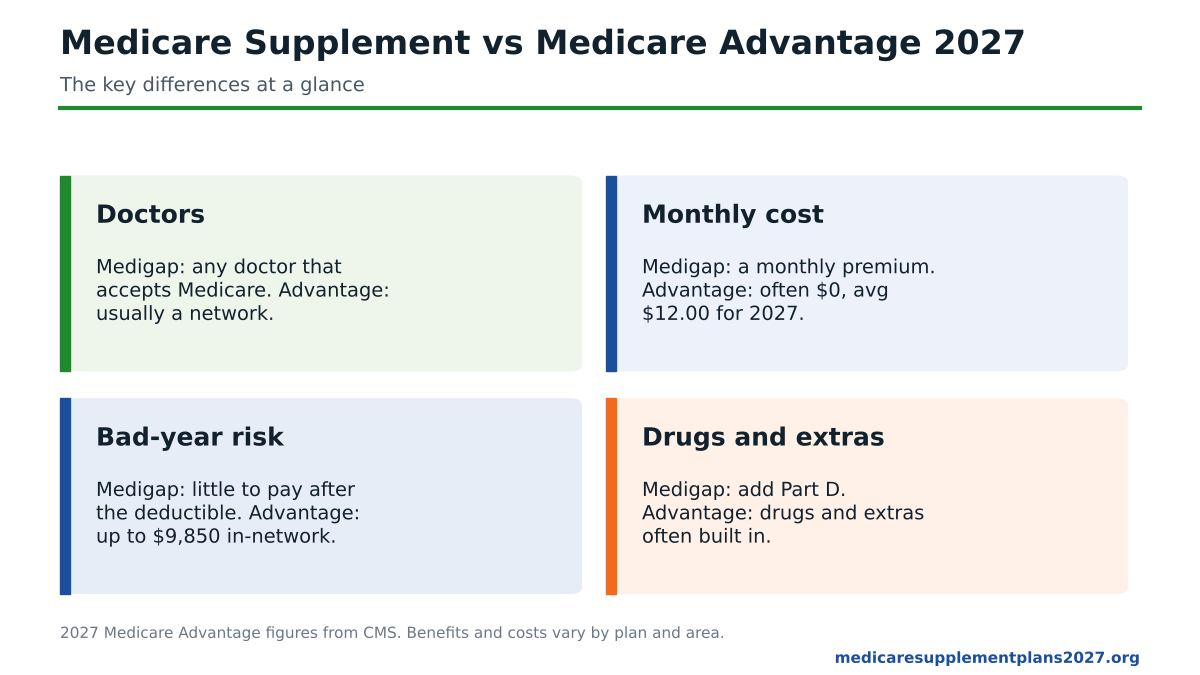
| Feature | Medicare Supplement | Medicare Advantage |
|---|---|---|
| Doctors | Any doctor that accepts Medicare, nationwide | Usually an HMO or PPO network |
| Referrals | None needed | Often required (HMO) |
| Monthly premium | Yes, varies by plan, age and ZIP | Often $0; CMS projects about $12 average for 2027 |
| Costs when you get care | Low or none, depending on the plan | Copays and coinsurance |
| Out-of-pocket limit | Plan G: mainly the Part B deductible | Up to $9,850 in-network for 2027 |
| Drug coverage | Add a separate Part D plan | Usually included |
| Dental, vision, hearing | Not included (some carriers offer riders) | Often included, with limits |
| Travel | Works in all 50 states; foreign travel emergency on most plans | Usually local network; emergencies covered |
| Plan changes | Benefits are standardized and stay the same | Benefits, networks and copays can change every year |
2027 Medicare Advantage figures from CMS. Benefits and costs vary by plan and area.
Compare 2027 Medicare Supplement Rates

How a Medicare Supplement Plan Works
A Medicare Supplement plan sits on top of Original Medicare (Parts A and B). Medicare pays first, and your Medigap plan pays most or all of what’s left. Because you stay on Original Medicare, you can see any doctor or hospital in the country that accepts Medicare, with no network and no referrals.
The benefits are standardized by the federal government. A Plan G pays the same benefits whether it comes from Mutual of Omaha, HealthSpring or Wellabe. The only real differences between carriers are price and service.
With Plan G, the main thing you pay out of pocket each year is the Part B deductible ($283 in 2026; the 2027 amount hasn’t been announced yet). You’ll pay a monthly premium for the plan, plus your Part B premium, plus a Part D drug plan if you want drug coverage.
How a Medicare Advantage Plan Works
A Medicare Advantage plan (Part C) replaces Original Medicare with a private plan. You still pay your Part B premium, but the Advantage plan handles your coverage. Most plans use an HMO or PPO network and include drug coverage, and many add dental, vision, hearing or fitness benefits.
Many Advantage plans have a $0 premium. CMS projects the average Medicare Advantage premium will be about $12 a month in 2027. The tradeoff is that you pay copays and coinsurance when you use care, up to the plan’s out-of-pocket limit. For 2027, that limit can be as high as $9,850 in-network, and higher if the plan covers out-of-network care.
Want the full rules on timing? See our guide to the Medigap Open Enrollment Period 2027. It covers when your 6-month window starts, pre-existing condition waits, and your options if you missed it.
See 2027 Medigap Rates in Your ZIP Code
Cost Comparison: A Good Year vs a Bad Year
The premium is only half the picture. What matters is your total yearly cost, and that depends on how much care you need.
- In a healthy year, a $0-premium Advantage plan will usually cost less. You pay little beyond a few copays.
- In a bad year (a hospital stay, surgery, cancer treatment, ongoing therapy), an Advantage plan can cost you up to its out-of-pocket limit. With Plan G, you’d mostly pay the Part B deductible and your premiums.
Put simply, Medigap costs you more upfront and protects you from big bills. Advantage costs you less upfront and leaves you more exposed when something goes wrong.
Which One Fits You in 2027?
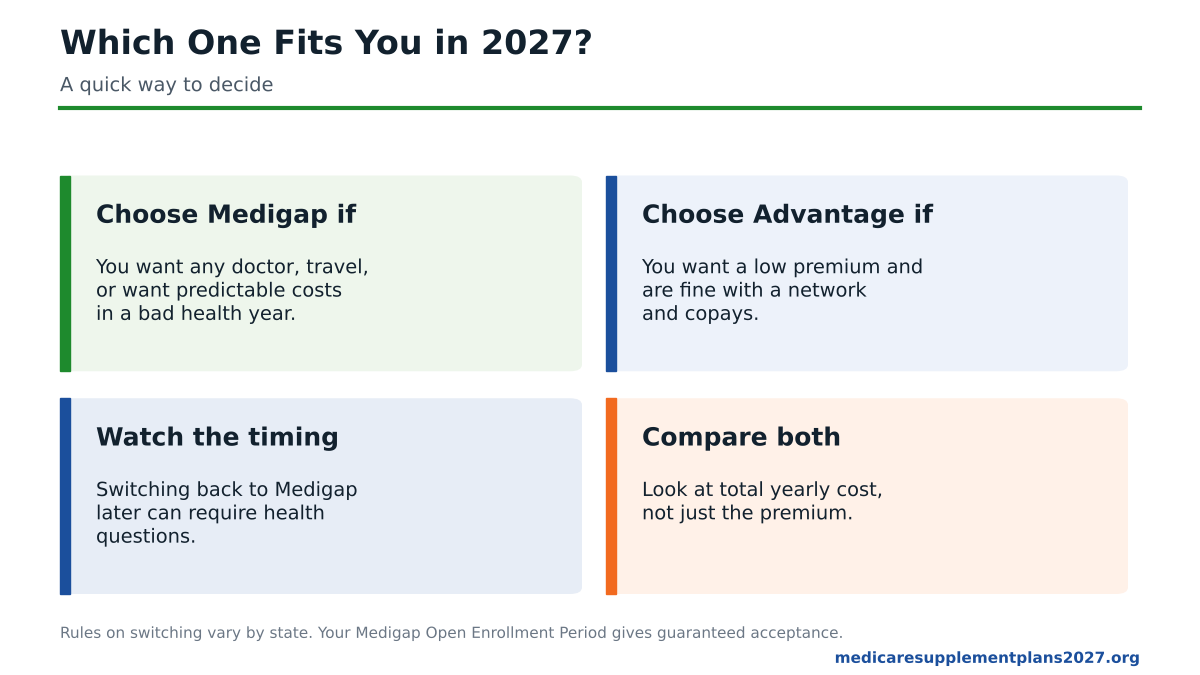
A Medicare Supplement may fit you better if:
- You want to keep your doctors and see specialists without referrals
- You travel, spend winters in another state, or split time between homes
- You want predictable costs and don’t want a large bill in a bad health year
- You have health conditions and expect to use care regularly
A Medicare Advantage plan may fit you better if:
- A low or $0 monthly premium matters most to you
- Your doctors are in the plan’s network and you stay local
- You want drug, dental and vision coverage bundled into one plan
- You’re comfortable paying copays when you use care
The Switching Trap: Why Timing Matters
Important: You can usually switch from Medigap to Medicare Advantage at any time during Open Enrollment. Going from Medicare Advantage back to Medigap is harder. Outside your Medigap Open Enrollment Period or a guaranteed issue right, most carriers can ask health questions and may decline you.
Your Medigap Open Enrollment Period is the 6 months starting the month you’re 65 or older and enrolled in Part B. During that window, carriers have to accept you at standard rates, whatever your health. That’s why many people choose Medigap first: it’s the one time you’re guaranteed to get it.
There’s also a trial right. If you join Medicare Advantage when you first get Medicare and leave within 12 months, you can usually go back to Original Medicare and buy a Medigap plan without health questions. A few states, such as New York and Connecticut, let you buy Medigap at any time. Rules vary, so check your state before you switch.
Can You Have Both?
No. A Medigap plan can’t pay costs under a Medicare Advantage plan, and it’s illegal for anyone to sell you Medigap while you’re on Medicare Advantage unless you’re switching back to Original Medicare. You choose one path: Original Medicare + Medigap + Part D, or Medicare Advantage.
Compare 2027 Medicare Supplement Rates & Benefits
Medicare Supplement vs Medicare Advantage FAQs
➤ What is the main difference between Medicare Supplement and Medicare Advantage?
A Medicare Supplement (Medigap) plan works alongside Original Medicare and helps pay your share of costs with any doctor or hospital that accepts Medicare. A Medicare Advantage plan replaces Original Medicare with a private plan that usually uses a network and charges copays.
➤ Which is cheaper in 2027, Medigap or Medicare Advantage?
Medicare Advantage usually has a lower monthly premium. CMS projects an average Medicare Advantage premium of about $12 a month for 2027, and many plans are $0. Medigap has a higher monthly premium but much lower costs when you need care, so the total yearly cost depends on how much care you use.
➤ What is the Medicare Advantage out-of-pocket maximum for 2027?
The 2027 in-network out-of-pocket limit for Medicare Advantage plans can be as high as $9,850. Many plans set a lower limit. With Medigap Plan G, you mainly pay the Part B deductible each year.
➤ Can I see any doctor with a Medicare Supplement plan?
Yes. A Medicare Supplement plan works with any doctor or hospital in the U.S. that accepts Medicare. You don’t need referrals and there is no network.
➤ Does Medigap include prescription drug coverage?
No. Medigap plans sold today don’t cover prescription drugs. Most people add a stand-alone Part D drug plan. Most Medicare Advantage plans include drug coverage.
➤ Can I switch from Medicare Advantage back to a Medicare Supplement?
You can try, but outside your Medigap Open Enrollment Period or a guaranteed issue right, most carriers can ask health questions and may decline you or charge more. Rules vary by state, and a few states give extra protections.
➤ Can I have Medigap and Medicare Advantage at the same time?
No. A Medigap plan can’t pay costs under a Medicare Advantage plan, and it’s illegal for anyone to sell you a Medigap plan if you’re on Medicare Advantage unless you’re switching back to Original Medicare.
➤ Which is better for someone who travels?
Medigap is usually better for travelers in the U.S. because it works with any Medicare provider nationwide. Many Medigap plans, including Plan G and Plan N, also include foreign travel emergency coverage. Medicare Advantage networks are usually local.
New to Medicare?
If you are new to Medicare, then you can enroll in a 2027 Medicare Supplement plan up to six months prior to your Medicare Part B effective date.
Call one of our licensed insurance agents to see what the best time frame is for you to enroll, based on your current situation. You can contact them at 1-855-409-6195.
Compare plans & benefits in your area
Or speak with a licensed insurance agent
1-855-409-6195TTY 711
Mon-Fri: 5am-7pm, Sat-Sun: 7am-4pm CT