





Speak with a licensed insurance agent

1-855-409-6195

TTY users 711 Mon-Fri: 5am-7pm, Sat-Sun: 7am-4pm CT
Advertisement

Do You Have to Renew Medicare Supplement Every Year? 2027 Renewal Rules Explained

Reviewed by Russell Noga, Licensed Medicare Insurance Broker (all 50 states) — Last updated November 12, 2026

No, you do not have to renew a Medicare Supplement policy every year: policies sold since 1992 are guaranteed renewable, so they roll over automatically as long as you pay the premium and your application was honest. There is no yearly re-enrollment form, and the fall enrollment season for Medicare Advantage and Part D does not touch your supplement.

2027 by the Numbers

$3,050

2027 deductible for high-deductible Plan G and F, up from $2,950 (CMS)

$292

2027 Part B deductible, up from $283 in 2026 (CMS)

Fall mail on Medicare can make it seem like every plan needs a fresh signature. A Medicare Supplement policy does not. Once issued, the same contract keeps running each January with no paperwork from you, even if your health has changed since you bought it.

What renewal does bring is a new price and, often, new deductibles. Below is what is locked in for 2027, what can move and a short yearly review. If you are still choosing a plan, our guide to how Medicare Supplement plans work covers the basics first.

Check Your 2027 Medicare Supplement Renewal Rate

Speak with a licensed insurance agent

1-855-409-6195TTY 711

Mon-Fri: 5am-7pm, Sat-Sun: 7am-4pm CT

Licensed insurance agent

Renewal Is Automatic: What Guaranteed Renewable Means

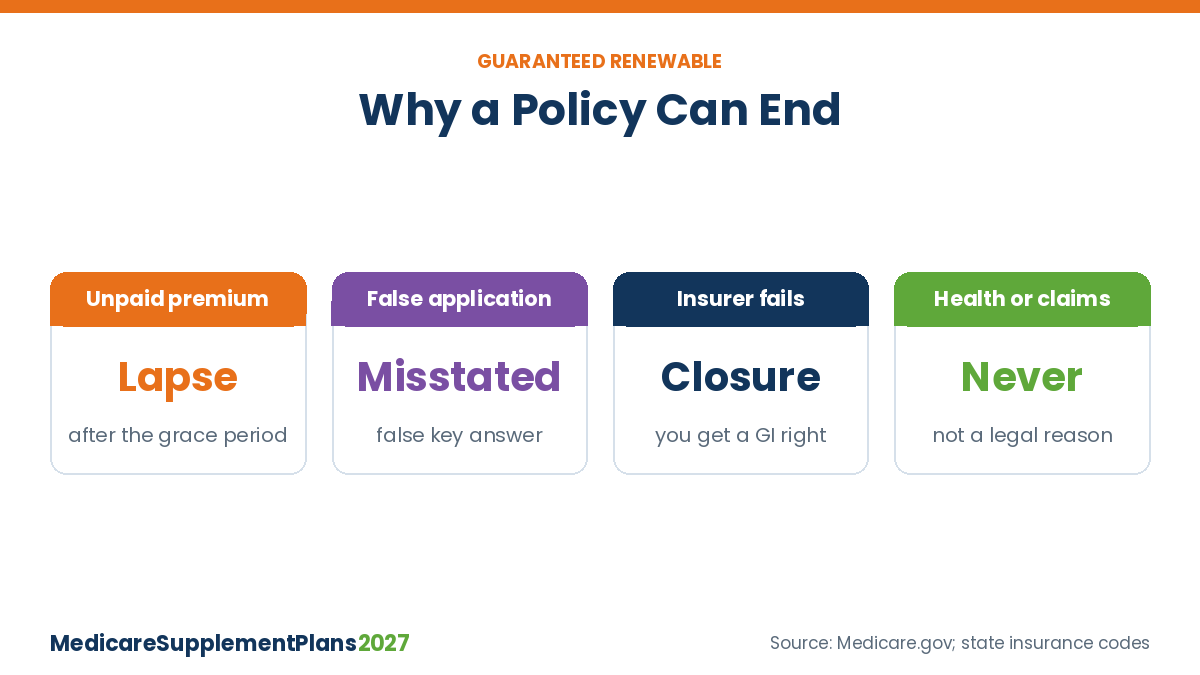
Do you have to renew Medicare Supplement every year: the only reasons a policy can end

Federal standards adopted in the early 1990s require every Medicare Supplement policy sold since 1992 to be guaranteed renewable. Washington’s insurance code, for example, says an insurer may not cancel or nonrenew a policy for any reason other than nonpayment of premium or material misrepresentation, and it bars cancellation because your health gets worse. Medicare.gov puts it the same way: standardized policies are automatically renewed every year, even if you have health problems.

Unpaid premium. If the bill goes unpaid past the grace period, the company may end the policy.

Material misrepresentation. Michigan’s insurance department defines this as knowingly answering an application question wrong in a way that changed your eligibility or price.

Company failure. If the insurer goes bankrupt, coverage can end, and you gain a guaranteed issue right to buy another plan.

Older policies: CMS notes that in some states an insurer may refuse to renew a policy bought before 1992. If yours is that old, read its renewal clause.

Medicare Supplement Quotes

Call a Licensed Agent Now

Compare 2027 Plan G, Plan N and more from several insurance companies in one call.

☎ 1-855-409-6195

Advertisement

TTY users 711  |  Mon–Fri: 5am–7pm, Sat–Sun: 7am–4pm CT

No obligation to enroll

What Stays Locked and What Can Move in 2027

Renewal keeps the contract alive, but the numbers around it reset. Some come from your insurer, some from Medicare.

Item Changes each year? 2026 to 2027 figure
Your plan letter and its benefits No. Benefits are standardized by federal law and cannot be cut Same coverage in 2027 as 2026
Your right to keep the policy No. Guaranteed renewable Renews with no action from you
Your monthly premium Yes. Set by the insurer, approved or filed with your state Varies by company, age and state
Part B deductible (paid by you on Plan G and Plan N) Yes. Set by Medicare each fall $283 in 2026; $292 in 2027
High-deductible Plan G or F deductible Yes. Indexed to inflation by CMS $2,950 in 2026; $3,050 in 2027
Part B premium (paid to Medicare, not your insurer) Yes. Set by Medicare each fall $202.90 in 2026; $209.40 in 2027

Sources: CMS high-deductible announcement for 2027; CMS 2027 Medicare Parts A and B fact sheet (November 17, 2026).

The plan letter is the one piece no company can touch, so an insurer cannot trim benefits at renewal to save money. Plans F and C keep renewing for people who hold them, even though they are sold only to people eligible for Medicare before 2020.

How Your Premium Is Reset at Each Renewal

How much your price moves depends partly on the pricing method in your outline of coverage. There are three.

Community rated. Everyone in an area pays the same price regardless of age.

Issue-age rated. The price is based on your age when you bought the policy. It still rises with inflation but not because you got older.

Attained-age rated. The price is based on your current age, so it climbs as you age. Often cheapest to start and costliest later.

Under any method, a company can only raise your price by raising it for everyone on the same policy form in your state. One carrier’s 2026 outline of coverage filed in Mississippi says the company will mail notice of a renewal premium change at least 60 days before the renewal date and that age-based increases on that form stop at 81. Our page on Plan G rate increases for 2027 covers recent increases.

Deductibles That Reset Every January

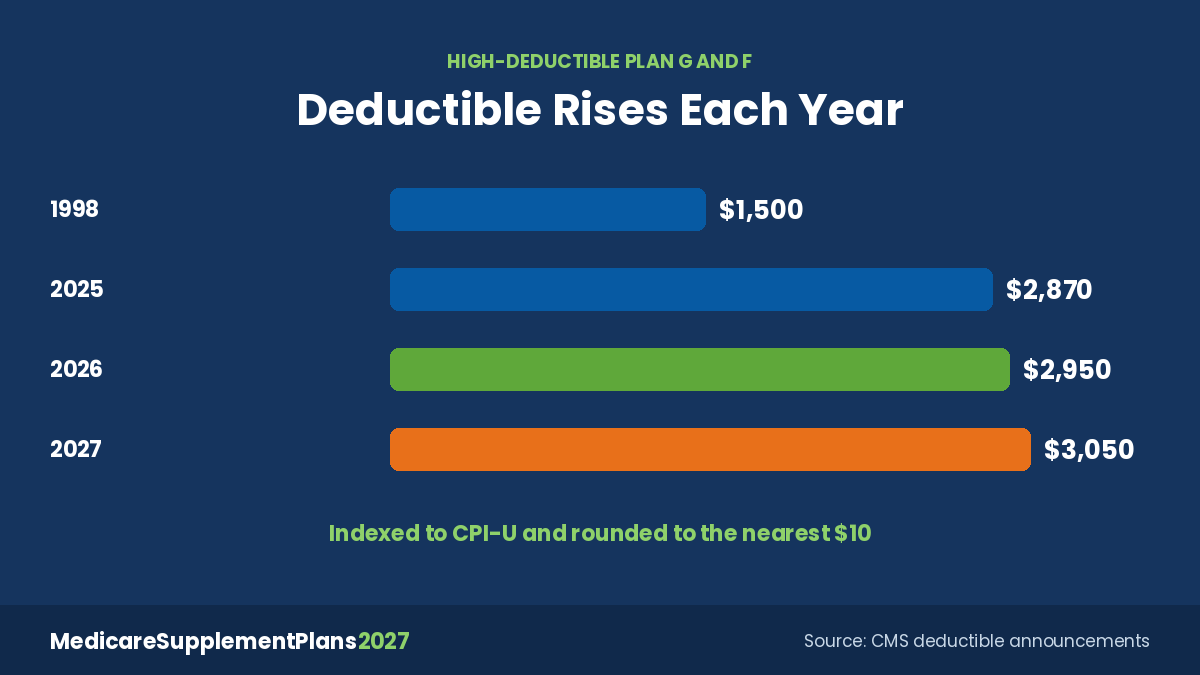
High-deductible Plan G deductible by year, showing why Medicare Supplement renewal costs change every year

Two deductibles move each year without any change to your policy. The first is the Part B deductible, which Plan G and Plan N leave for you to pay. For 2027 it is $292, pending the final CMS figure.

The second applies only to high-deductible Plan G and Plan F. Federal law set this deductible at $1,500 for 1998 and grows it each year by the change in the Consumer Price Index, rounded to the nearest $10. For 2027 CMS set it at $3,050. The premium may stay low, but your possible cost before the plan pays rises every year. Our high-deductible Plan G guide weighs that trade-off.

Worth knowing: Both deductibles generally run on the calendar year, not on your policy anniversary. A policy that renews in June still starts the Part B deductible over on January 1.

Compare plans & benefits in your area

Or speak with a licensed insurance agent

1-855-409-6195TTY 711

Mon-Fri: 5am-7pm, Sat-Sun: 7am-4pm CT

Licensed insurance agent

Missed Payments, Moves and Medicaid

Since nonpayment is the main way a policy ends, your billing date matters more than any renewal date. Most policies give a grace period after the due date. The length is set by the policy and state law; the Mississippi outline mentioned above prints a 31-day grace period, but yours may differ. Once a policy lapses, the company does not have to take you back, and buying a new one later may mean health questions.

1

Set up automatic payment. Bank draft removes the most common reason a policy ends by accident.

2

Call the company right away if a bill is late. Ask for the exact grace period end date in writing.

Moving does not end a policy either. Medicare.gov says you can keep your current policy no matter where you live as long as you stay in Original Medicare, though the premium may change to match your new area. Medicare SELECT is the exception: it uses a local network, so a move may give you the right to pick another plan.

Medicaid rule: If you become eligible for Medicaid, you can ask your insurer to suspend benefits and premiums for up to 24 months instead of canceling, according to Michigan’s insurance department.

A Yearly Renewal Checklist That Takes One Hour

Doing nothing keeps your coverage. Doing a short review keeps your price in check.

1

Read the rate letter. Note the new premium and its start date.

2

Price the same plan letter elsewhere. Benefits are identical across companies, so only price and service differ.

3

Check whether you would face health questions. In most states a new company can review your health first. Our underwriting guide explains how.

4

See if your state gives a yearly switching window. Oregon, Illinois, Kentucky, Maryland and Virginia are among the states with a birthday window, and New Mexico’s begins in 2027. See the full list on our birthday rule page.

5

Keep the old policy until the new one is approved. Never cancel first. A lapse can cost you the right to choose.

Separate calendar: A stand-alone Part D drug plan can change its premium and drug list each year, and its change window runs October 15 to December 7. That window has no effect on your supplement.

Bottom Line

A Medicare Supplement policy renews itself every year as long as the premium is paid, and the company cannot cancel it because of your health or claims. What changes is the price and the Medicare deductibles, so a yearly look at your rate letter is worth the time.

Price your plan letter with other carriers in your ZIP code

Speak with a licensed insurance agent

1-855-409-6195TTY 711

Mon-Fri: 5am-7pm, Sat-Sun: 7am-4pm CT

Licensed insurance agent

Medicare Supplement Renewal — Frequently Asked Questions

➤ Do I need to sign anything to keep my Medicare Supplement in 2027?

No. The policy continues into 2027 on its own.

➤ Can my insurer drop me because I filed a lot of claims?

No. Claims and health changes are not allowed reasons to end a policy.

➤ Why did my renewal premium go up if my coverage stayed the same?

Premiums reflect medical costs for everyone on your policy form in your state, and on attained-age policies, your age.

➤ Does Medicare send me a reminder to renew my supplement?

No. Medicare does not manage your supplement. Any notice comes from your insurer, usually as a rate letter.

➤ What happens if my Medicare Supplement company stops selling my plan?

If it stops selling the plan but stays in business, your existing policy keeps renewing. If the company goes bankrupt and coverage ends, you get a guaranteed issue right to buy another plan.

➤ Is my high-deductible Plan G deductible the same every year?

No. CMS raises it each year with inflation. It is $3,050 for 2027, up from $2,950 in 2026.

➤ Will my supplement renew if I move to another state?

Yes, as long as you stay in Original Medicare. The premium may change to the rate for your new area, and Medicare SELECT holders may need a new plan.

➤ Can I pause my supplement instead of canceling it?

Generally only if you become eligible for Medicaid, which allows a suspension of up to 24 months. In other cases, stopping payment ends the policy.

New to Medicare?

If you are new to Medicare, then you can enroll in a 2027 Medicare Supplement plan up to six months prior to your Medicare Part B effective date.

Call one of our licensed insurance agents to see what the best time frame is for you to enroll, based on your current situation. You can contact them at 1-855-409-6195.

Medicare Supplement Quotes

Call a Licensed Agent Now

Compare 2027 Plan G, Plan N and more from several insurance companies in one call.

☎ 1-855-409-6195

Advertisement

TTY users 711  |  Mon–Fri: 5am–7pm, Sat–Sun: 7am–4pm CT

No obligation to enroll

Compare plans & benefits in your area

Or speak with a licensed insurance agent

1-855-409-6195TTY 711

Mon-Fri: 5am-7pm, Sat-Sun: 7am-4pm CT

Licensed insurance agent