





Speak with a licensed insurance agent

1-855-409-6195

TTY users 711 Mon-Fri: 5am-7pm, Sat-Sun: 7am-4pm CT
Advertisement

Medicare Supplement Underwriting 2027: Health Questions, Checks and Outcomes

Reviewed by Russell Noga, Licensed Medicare Insurance Broker (all 50 states) — Last updated November 8, 2026

Medicare Supplement underwriting is the health review a company may run on your application before it decides whether to sell you a plan and at what rate. It applies when you buy outside your Medigap Open Enrollment Period and without a guaranteed issue right or a state rule that blocks it.

2027 by the Numbers

74%

of Medicare Advantage enrollees have a condition that could lead to a denial (KFF, 2023 data)

6 months

longest pre-existing condition wait a plan can apply (federal rules)

16

states with a birthday rule for 2027 (KFF, October 2026)

2

states with year-round guaranteed issue for people 65+: New York and Connecticut

Turning 65 and signing up for Part B starts a short window when any Medicare Supplement company must accept you. Once that window passes, the rules flip. In most states a company can read your medical history, look up your prescriptions and say no.

This page follows a 2027 application from the first health question to the final decision. If you are still inside your first window, read about the Medigap Open Enrollment Period first, because you can skip underwriting entirely.

Compare 2027 Medicare Supplement Rates Before You Apply

Speak with a licensed insurance agent

1-855-409-6195TTY 711

Mon-Fri: 5am-7pm, Sat-Sun: 7am-4pm CT

Licensed insurance agent

What Medicare Supplement Underwriting Looks At

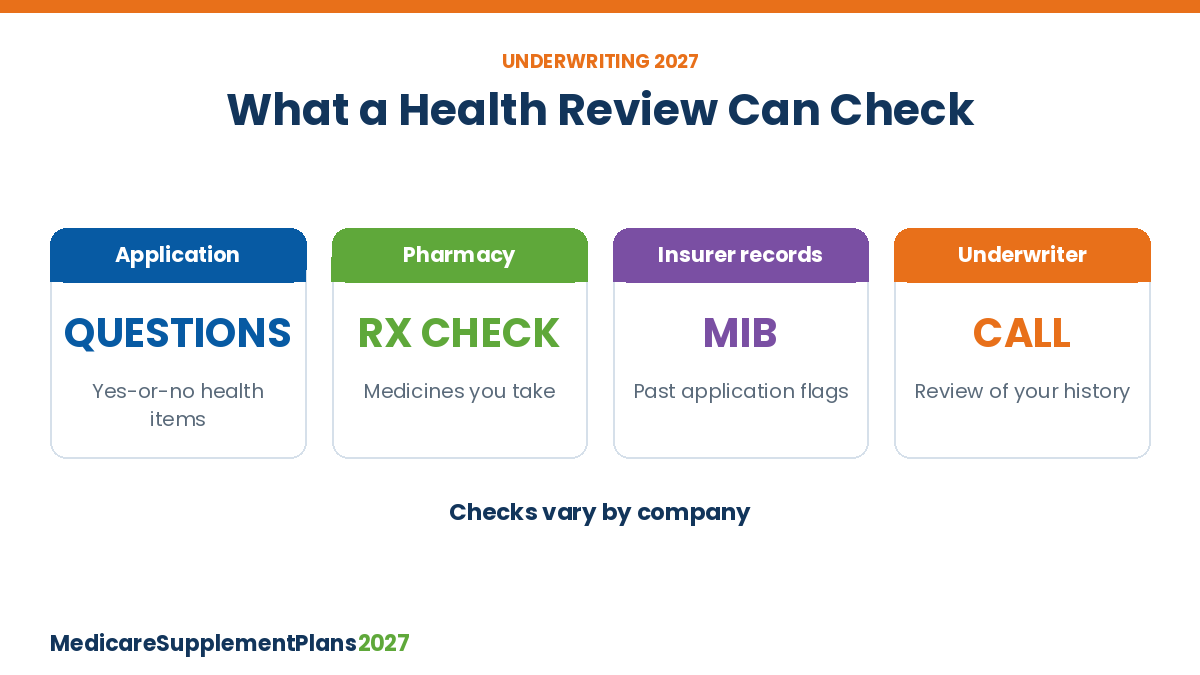
Medicare Supplement underwriting in 2027: the four checks a company may run on your application

Underwriting is a risk check. The company wants to know how likely you are to need costly care soon, since its plan pays most of what Original Medicare leaves behind. Every company writes its own rules, so one may approve an applicant another turns down.

Your answers. The application lists yes-or-no health questions. A single yes on a serious item can end the review.

Your medicine list. Drugs reveal conditions. Many companies compare what you list with pharmacy records.

Shared insurer records. Some companies check a database that member insurers use to flag details from past applications.

A conversation. An underwriter may call to go over your history, medicines and any recent care.

Underwriting affects whether you are accepted and your rate class, never the benefits. A Plan G approved after a health review covers the same things as one sold with no questions.

Medicare Supplement Quotes

Call a Licensed Agent Now

Compare 2027 Plan G, Plan N and more from several insurance companies in one call.

☎ 1-855-409-6195

Advertisement

TTY users 711  |  Mon–Fri: 5am–7pm, Sat–Sun: 7am–4pm CT

No obligation to enroll

When Health Questions Apply and When They Do Not

Your situation in 2027 Can the company underwrite? Learn more
First 6 months you are 65 or older and have Part B No. Any plan the company sells, at its best health rate Medigap Open Enrollment
Coverage loss or other federal qualifying event, within the deadline No, for the plan letters that event allows Guaranteed issue rights
Inside your state’s yearly birthday or anniversary window No, for a plan the state rule allows State rules below
Leaving Medicare Advantage after the first-year trial Yes, in most states Switching from Medicare Advantage
Changing companies or plan letters any other time Yes, in most states Full health review

Federal rules from Medicare. Some states add protections or apply different rules to people under 65.

The Kinds of Health Questions on the Application

Question lists differ from company to company, and the look-back time for each question varies too. Most applications group their questions into a few broad types.

Knock-out conditions. Serious diagnoses such as kidney failure needing dialysis, heart failure, certain cancers under treatment, dementia or a past organ transplant often lead straight to a decline.

Recent care. Hospital stays, nursing home or home health care, or surgery that a doctor has advised but not yet done.

Current medicines. Prescriptions tied to conditions such as diabetes with complications, lung disease or heart rhythm problems.

Height, weight and tobacco. Many companies compare your build with a chart, and many charge tobacco users a higher rate.

Read every question: Each question sets its own time frame, such as the past 2 years or the past 5 years. A condition outside that time frame does not count as a yes on that question.

Behind the Scenes: Prescription, MIB and Phone Checks

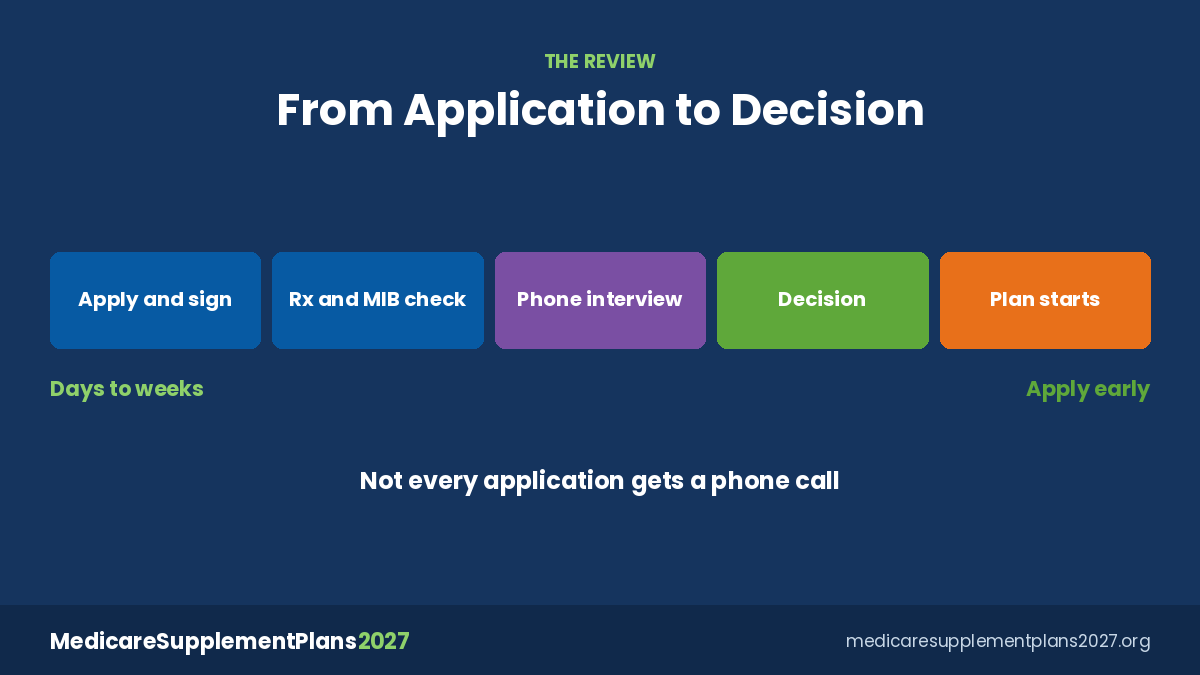
Medicare Supplement underwriting steps from application to decision
1

You sign an authorization. The application includes a permission form that lets the company review medical and pharmacy records.

2

Prescription history is pulled. Many companies check pharmacy claim records to confirm the medicines you listed and spot ones you left off.

3

MIB may be checked. MIB is a database member insurers share. You can ask MIB for your own file free once a year, and its rules say a company cannot base a decision on the file alone.

4

An underwriter may call. A phone interview goes over your answers in more detail. Not every applicant gets one.

5

A decision is issued. Reviews can take a few days to several weeks. Apply well before the date you want coverage to start.

Compare plans & benefits in your area

Or speak with a licensed insurance agent

1-855-409-6195TTY 711

Mon-Fri: 5am-7pm, Sat-Sun: 7am-4pm CT

Licensed insurance agent

Possible Results and the 6-Month Pre-Existing Wait

Underwriting result What it means for you
Approved at the preferred rate The company’s lowest health class, often tied to being tobacco-free
Approved at a standard or higher rate Same benefits, but a higher premium because of tobacco use or health; not every company uses extra tiers
Approved with a pre-existing condition wait Up to 6 months before the plan pays for a condition treated in the 6 months before the plan starts
Declined No plan from that company for now; you may still apply elsewhere

Rate classes and decisions vary by company. Benefits for each plan letter are set by law and do not change with your result.

The wait can shrink. Each month of prior coverage that counts, such as an employer plan, removes a month from the wait, as long as the break between plans is 63 days or less. Six months of that coverage erases the wait completely.

Answer honestly: Leaving out a diagnosis or a medicine that pharmacy records will show can lead to a decline. If it is found after approval, the company may be able to cancel the plan or contest claims.

State Laws That Limit Underwriting in 2027

Federal rules let most states allow underwriting after your first window, but a growing group of states narrows it.

State How it limits underwriting Main catch
New York, Connecticut Companies must accept applicants all year None on acceptance; rules for people under 65 differ
Massachusetts State rule sets a yearly window from February 1 to March 31; insurers sell year-round in practice Uses its own plan designs, not standard letters
Maine A one-month guaranteed issue period every year for at least Plan A, plus switching with no gap over 90 days Plan choices in the yearly period can be limited
Washington Policyholders can switch any time to equal or lesser benefits Must have no gap over 90 days; Plan A can only move to Plan A
Minnesota A yearly enrollment period with no underwriting, started August 2026 Check the state for who qualifies and dates
Delaware Companies cannot deny an application May still charge more for health and apply a 6-month wait
Missouri Same-benefit switch near your policy anniversary Must already own a plan
16 birthday rule states Yearly window to switch without health questions Must already own a plan; limits on plan letters

Our summary of KFF’s state review (October 2026) and the Minnesota Commerce Department. Rules change; confirm with your state insurance department.

Window lengths and plan limits for each birthday state are on our Medicare Supplement birthday rule page. For the full switching process, see whether you can change Medicare Supplement plans.

Bottom Line

Medicare Supplement underwriting decides whether a company will sell you a plan and at what price once your protected windows have passed. Know which right or state rule applies to you, list every medicine and diagnosis honestly, and apply early so a decline or delay never leaves you without coverage in 2027.

See 2027 Medicare Supplement prices in your ZIP code

Speak with a licensed insurance agent

1-855-409-6195TTY 711

Mon-Fri: 5am-7pm, Sat-Sun: 7am-4pm CT

Licensed insurance agent

Medicare Supplement Underwriting — Frequently Asked Questions

➤ What does underwriting mean on a Medicare Supplement application?

It is the company’s review of your health history, medicines and recent care. The company uses it to decide whether to accept you, which rate class you get and whether a pre-existing condition wait applies.

➤ Do all companies use the same health questions?

No. Each company writes its own application and decision rules, so a condition that leads to a decline at one company may be accepted at another. Look-back periods on each question also vary.

➤ Can a Medicare Supplement company see my prescription history?

Many companies check pharmacy records after you sign the authorization in the application, so list every medicine you take.

➤ How long does the underwriting review take?

Many decisions come within a few days, but a phone interview or a records request can stretch it to several weeks. Applying a month or more ahead gives you room.

➤ If one company declines me, can I apply with another?

Yes. A decline applies only to that company. Another company with different rules may accept you, though it will run its own review.

➤ Can underwriting raise my premium instead of declining me?

Yes. Some companies place applicants in higher rate classes for tobacco use or certain health issues. Others only approve or decline, so results vary by company.

➤ Does underwriting apply if I am under 65 on Medicare?

Rules for people under 65 depend on the state. Some states require companies to sell at least one plan when you first get Part B, while others allow underwriting or offer no access at all.

➤ How do I get a copy of my MIB file?

You can request your MIB consumer file free once a year. If a file exists, you can review it and dispute anything that is wrong before you apply.

New to Medicare?

If you are new to Medicare, then you can enroll in a 2027 Medicare Supplement plan up to six months prior to your Medicare Part B effective date.

Call one of our licensed insurance agents to see what the best time frame is for you to enroll, based on your current situation. You can contact them at 1-855-409-6195.

Medicare Supplement Quotes

Call a Licensed Agent Now

Compare 2027 Plan G, Plan N and more from several insurance companies in one call.

☎ 1-855-409-6195

Advertisement

TTY users 711  |  Mon–Fri: 5am–7pm, Sat–Sun: 7am–4pm CT

No obligation to enroll

Compare plans & benefits in your area

Or speak with a licensed insurance agent

1-855-409-6195TTY 711

Mon-Fri: 5am-7pm, Sat-Sun: 7am-4pm CT

Licensed insurance agent