





Speak with a licensed insurance agent

1-855-409-6195

TTY users 711 Mon-Fri: 5am-7pm, Sat-Sun: 7am-4pm CT
Advertisement

Worst Medicare Supplement Companies 2027: Five Public Records That Expose a Bad Insurer

Reviewed by Russell Noga, Licensed Medicare Insurance Broker (all 50 states) — Last updated November 7, 2026

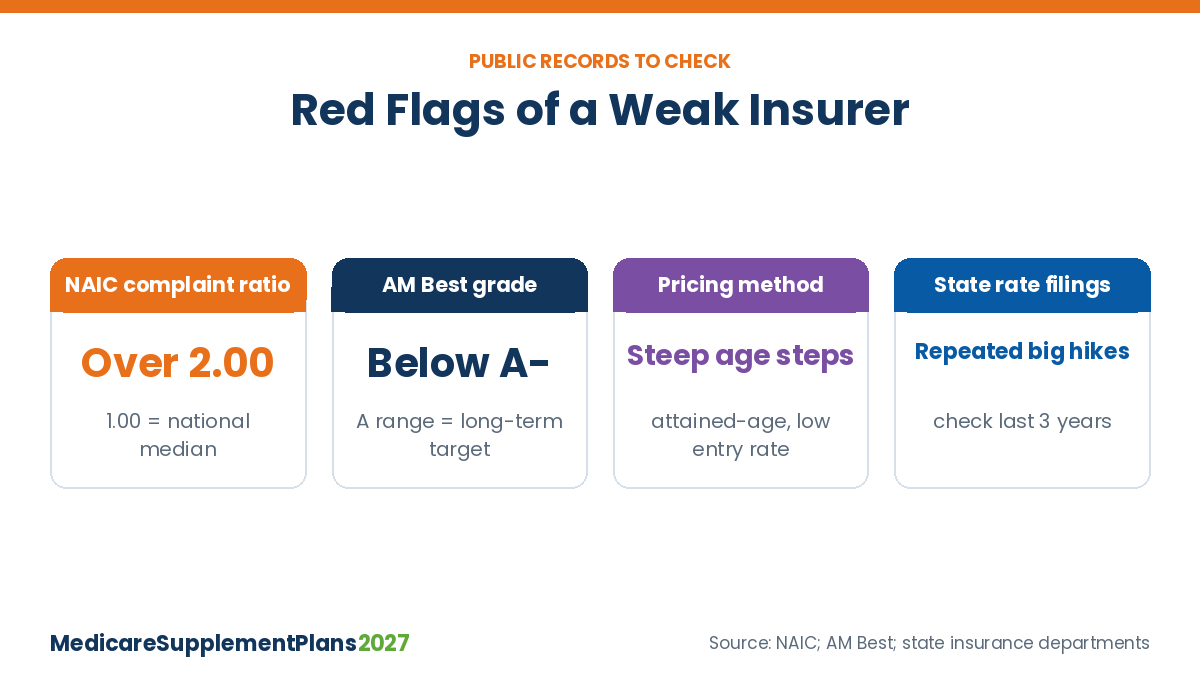
The worst Medicare Supplement companies are the ones with a complaint ratio well above 1.00 on the NAIC’s Consumer Insurance Search, an AM Best grade below the A range, attained-age pricing with steep age steps and a record of large rate filings in your state. Every company’s Plan G pays the same standardized benefits, so a bad company shows up in price and service records, not coverage.

2027 by the Numbers

1.00

NAIC national median complaint ratio; higher means more complaints than its size predicts (NAIC CIS)

65%

minimum share of individual Medicare Supplement premiums that must go to claims (federal loss ratio rule)

8

states that require community-rated pricing, per a 2025 peer-reviewed study

16

states with a birthday rule that lets current policyholders switch each year (KFF)

Search results for this topic are crowded with ranked lists that name ten carriers as the worst, rarely with any math behind them.

A better approach is to read the public records regulators use. Below are five of them, what a warning sign looks like in each, and a short check for any quote. For ratings of the major names, see our Medicare Supplement reviews for 2027.

Compare 2027 Medicare Supplement Companies Side by Side

Speak with a licensed insurance agent

1-855-409-6195TTY 711

Mon-Fri: 5am-7pm, Sat-Sun: 7am-4pm CT

Licensed insurance agent

Same Benefits, Different Behavior: Where a Bad Company Hides

Scorecard of public records that identify the worst Medicare Supplement companies: complaint ratio, AM Best grade, pricing method and rate filings

Outside Massachusetts, Minnesota and Wisconsin, each lettered plan carries a federal benefit design. A Plan G from a small regional insurer pays the same share of the same Medicare-approved bills as a Plan G from a household name.

Price path. How the premium is set at sign-up and how fast it climbs later.

Money to pay claims. Whether the insurer has reserves to keep paying for decades.

Service record. How often policyholders file formal complaints with regulators.

Reality check: Online star reviews often blame the supplement company for a denial Medicare made first. When Medicare refuses a service, a Medicare Supplement generally has nothing to pay, so those reviews say little about the insurer.

Medicare Supplement Quotes

Call a Licensed Agent Now

Compare 2027 Plan G, Plan N and more from several insurance companies in one call.

☎ 1-855-409-6195

Advertisement

TTY users 711  |  Mon–Fri: 5am–7pm, Sat–Sun: 7am–4pm CT

No obligation to enroll

Record 1: The NAIC Complaint Index

The National Association of Insurance Commissioners collects closed complaints from state insurance departments. Its complaint ratio compares a company’s share of complaints with its share of premiums for one line of coverage. A score of 1.00 is the national median; 2.00 means about twice the complaints its size predicts.

1

Open the NAIC Consumer Insurance Search. Enter the insurer’s exact legal name and your state. The company on your quote may be a subsidiary with its own record.

2

Choose the health line. Pick the life, accident and health or health option that matches the company’s statement type.

3

Read the complaint ratio and trend. Compare it with 1.00, then check whether complaints are rising or falling.

4

Open the counts by code. This report lists why people complained: claim delays, denials, billing or premium problems.

Complaint ratio What it suggests How to treat it
Under 1.00 Fewer complaints than its premium share predicts Good sign
About 1.00 In line with the national median Neutral
1.50 to 2.00 Noticeably more complaints than its size Ask why
Over 2.00 Twice the expected complaints or more Red flag

Ratio and 1.00 benchmark per NAIC complaint data as described by state regulators and Kiplinger. Small insurers can swing widely on a few complaints.

Record 2: AM Best Financial Strength Grade

AM Best grades an insurer’s ability to pay claims, which matters for a policy you may keep 20 years or more. The scale runs from A++ down to D, with separate letters for companies regulators have stepped into.

AM Best grade Category What it means for a supplement buyer
A++, A+ Superior Strongest claims-paying ability
A, A- Excellent Solid choice for long-term coverage
B++, B+ Good Acceptable, but compare with A-rated options
B, B- Fair Vulnerable in bad economic conditions
C++ to D Marginal to Poor Avoid for long-term coverage
E / F / S Supervised / Liquidation / Suspended Do not buy; check your guaranteed issue rights

Scale per AM Best rating definitions. Some smaller companies are not rated by AM Best.

A strong grade does not promise a steady price. A top-rated company can still file large increases, so read this record next to the next two.

Record 3: The Pricing Method on Page One of the Outline

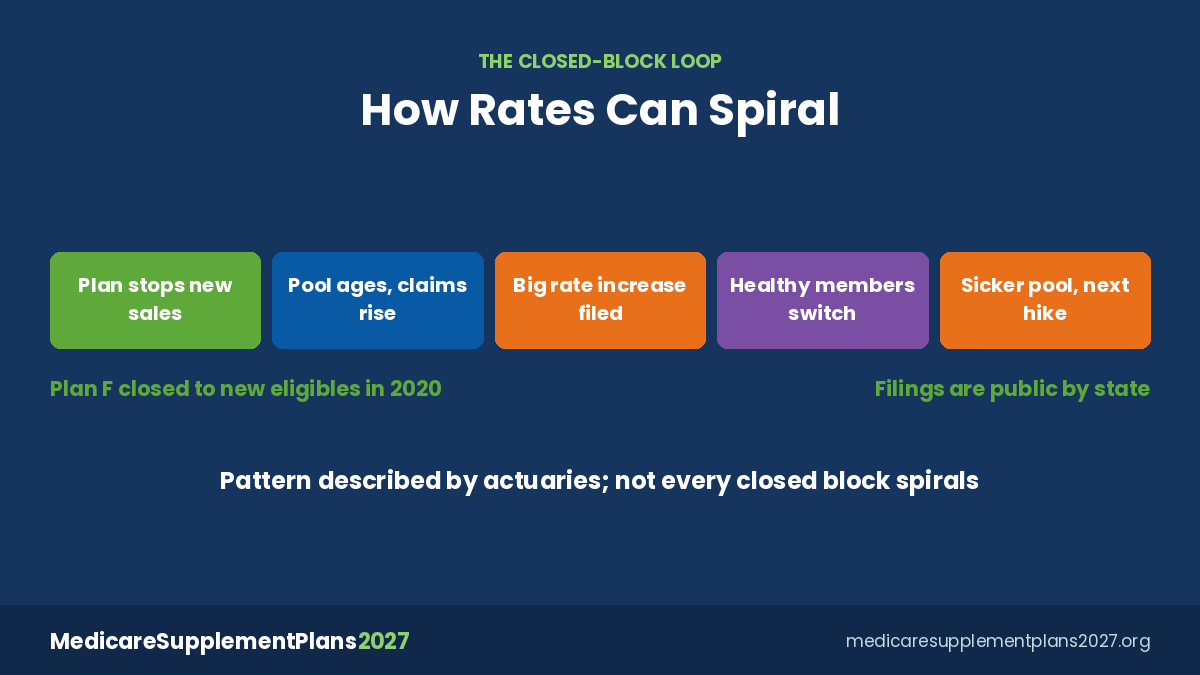
How a closed block can push up Medicare Supplement rates at weaker companies

Every Medicare Supplement sets your premium one of three ways as you age. The method is printed in the outline of coverage and shapes your long-run cost more than a first-year price.

Pricing method How age affects the premium Where it applies
Community-rated Same rate for everyone on the plan, whatever their age Required in Arkansas, Connecticut, Maine, Massachusetts, Minnesota, New York, Vermont and Washington
Issue-age-rated Set by your age when you buy; does not rise just because you age Offered by some companies in some states
Attained-age-rated Rises as you get older, on top of any general increase Widely used in most other states

State list per a 2025 peer-reviewed study (PMC); some sources add Idaho, so confirm with your state. Any method can still see general increases.

Attained-age pricing is not bad by itself and often starts lowest at 65. The warning sign is a very low entry price paired with steep age steps.

Compare plans & benefits in your area

Or speak with a licensed insurance agent

1-855-409-6195TTY 711

Mon-Fri: 5am-7pm, Sat-Sun: 7am-4pm CT

Licensed insurance agent

Record 4: Rate Filings and the Closed-Block Trap

Rate increases are not secret. Insurers file them with each state, and many states post filings through the public SERFF Filing Access search. A filing usually shows the requested increase, the approved amount and the claims behind it.

What a closed block is. Policies the company no longer sells to new buyers. With no younger members joining, the pool can only age.

How the spiral starts. Healthier members leave after an increase, so the next increase is larger.

A built-in example. Plan F closed to people newly eligible for Medicare on or after January 1, 2020, so every Plan F pool now ages with no new entrants.

A floor on value. Federal rules require individual policies to pay out at least 65% of premiums in claims over time.

Ask for the last three years of increases on your plan letter in your state, then confirm them in the filings. Our page on Plan G rate increases for 2027 explains what drives them.

Record 5: Health Questions, Claims Handling and Your Way Out

During your six-month Medigap Open Enrollment Period, a company cannot turn you down or charge more for health history. Outside it, most companies can ask health questions, and that screening is what traps people with a company whose prices keep rising. Claims are rarely the problem, since Medicare usually forwards them to the supplement automatically.

1

Note your state’s switching rules. Sixteen states have a yearly birthday rule; Connecticut and New York require guaranteed issue year-round at 65 and older.

2

Know the insolvency right. If your insurer goes bankrupt or commits fraud, federal law gives you a guaranteed issue right to another policy.

3

Apply before you cancel. Keep the current policy until a new company approves you in writing.

4

Compare the same letter. Switching Plan G to Plan G changes the price, never the benefits. See our guide on changing Medicare Supplement plans.

Rule to remember: A company that will not show its rate history, cannot name its pricing method or pushes a same-day decision shows the warning sign before the records do.

Bottom Line

No agency publishes a list of the worst Medicare Supplement companies, but the records that would build one are free: the NAIC complaint ratio, the AM Best grade, the pricing method and the state rate filings. Check all four on every quote and choose the company whose records hold up, not the lowest first-year price.

Check 2027 supplement prices from stable companies in your ZIP code

Speak with a licensed insurance agent

1-855-409-6195TTY 711

Mon-Fri: 5am-7pm, Sat-Sun: 7am-4pm CT

Licensed insurance agent

Worst Medicare Supplement Companies — Frequently Asked Questions

➤ Is there an official ranking of the worst Medicare Supplement insurers?

No. Medicare and the NAIC do not rank supplement companies. The NAIC publishes complaint ratios and many states post rate filings, which together show weaker records.

➤ Can a bad company give me a worse Plan G?

No. Plan G benefits are set by federal rules, so every company’s Plan G pays the same share of Medicare-approved costs. Price, rate increases, financial strength and service are what differ.

➤ What complaint ratio should worry me?

The NAIC national median is 1.00. A ratio near or over 2.00 means far more complaints than the company’s size predicts, so read the complaint codes.

➤ What AM Best grade is too low for a supplement company?

The A range is the usual target for long-term coverage. B or below is rated fair or weaker, and E or F means regulators have stepped in or the company is in liquidation.

➤ Why did my premium jump so much this year?

Usually an attained-age step, a general rate increase filed with your state, or both. Closed blocks of policies tend to see larger increases.

➤ What happens if my Medicare Supplement company goes bankrupt?

Federal law gives you a guaranteed issue right to buy another Medicare Supplement policy when your insurer goes bankrupt or coverage ends through no fault of your own.

➤ Where can I see a company’s past rate increases?

Your state insurance department. Many states let the public search Medicare Supplement rate filings through SERFF Filing Access or a state rate page.

➤ Is the cheapest Medicare Supplement company always the worst?

No. A low price with a strong grade, a low complaint ratio and steady filings can be the best buy.

New to Medicare?

If you are new to Medicare, then you can enroll in a 2027 Medicare Supplement plan up to six months prior to your Medicare Part B effective date.

Call one of our licensed insurance agents to see what the best time frame is for you to enroll, based on your current situation. You can contact them at 1-855-409-6195.

Medicare Supplement Quotes

Call a Licensed Agent Now

Compare 2027 Plan G, Plan N and more from several insurance companies in one call.

☎ 1-855-409-6195

Advertisement

TTY users 711  |  Mon–Fri: 5am–7pm, Sat–Sun: 7am–4pm CT

No obligation to enroll

Compare plans & benefits in your area

Or speak with a licensed insurance agent

1-855-409-6195TTY 711

Mon-Fri: 5am-7pm, Sat-Sun: 7am-4pm CT

Licensed insurance agent