





Speak with a licensed insurance agent

1-855-409-6195

TTY user 711 Mon-Fri : 8am-9pm EST

Medicare Supplement Plan G 2027

Reviewed by Russell Noga, Licensed Medicare Insurance Broker (all 50 states) — Last updated August 16, 2026


Medicare Supplement Plan G is the most comprehensive Medigap plan available to anyone who became eligible for Medicare on or after January 1, 2020. It pays every gap Original Medicare leaves — hospital deductible, the 20% Part B coinsurance, excess charges, skilled nursing coinsurance — with one exception.

That exception is the annual Part B deductible, $283 in 2026. This will rise in 2027, and the exact amount will be released and updated on this website in October.

You pay this deductible once per calendar year. After that, covered Medicare services cost you nothing.

Because Medigap benefits are standardized by federal law, Plan G from one carrier is identical to Plan G from any other. Only the price differs. Enter your ZIP code above to compare 2027 Medicare Supplement Plans and rates from carriers licensed in your state.

What Medicare Supplement Plan G Covers

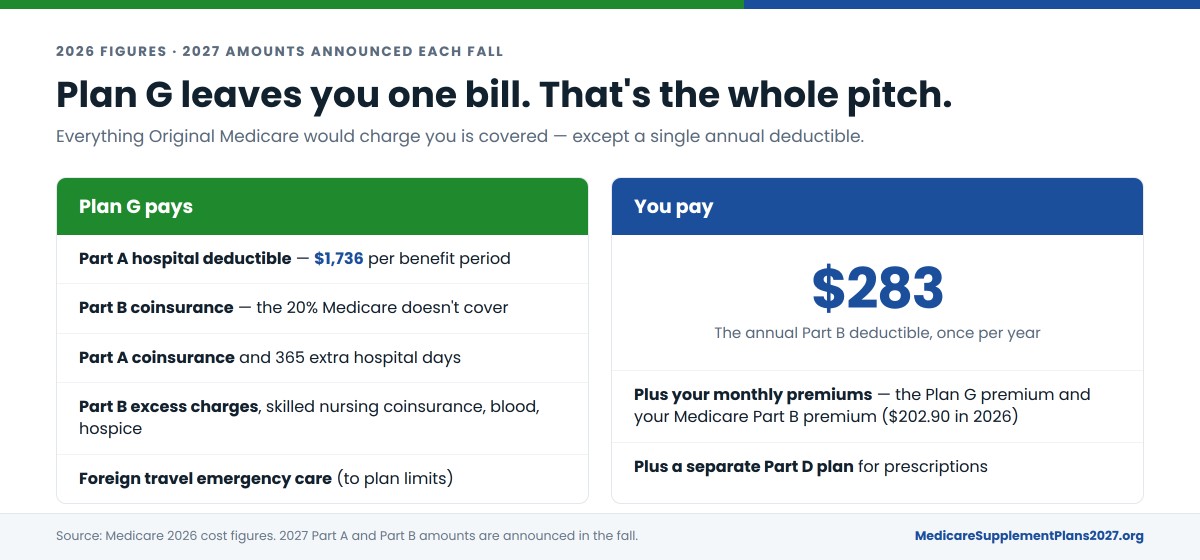
Medicare Supplement Plan G covers the Part A hospital deductible of $1,736, Part B coinsurance, Part A coinsurance, Part B excess charges and foreign travel emergency care, leaving you only the $283 annual Part B deductible


Benefit Plan G pays 2026 amount
Part A hospital deductible 100% $1,736 per benefit period
Part B coinsurance 100% The 20% Medicare doesn’t pay
Part A coinsurance and hospital costs 100% Plus 365 additional days
Part B excess charges 100% Up to 15% above Medicare’s rate
Skilled nursing facility coinsurance 100% Days 21–100
Foreign travel emergency 80% To plan limits, after deductible
Part B annual deductible You pay $283 per year

The 2027 Part A and Part B amounts are announced in the fall for the following year. The structure doesn’t change — only the dollar figures do.

View Plan G Rates from the top companies

Speak with a licensed insurance agent

1-855-409-6195TTY 711

Mon-Fri: 8am-9pm ET

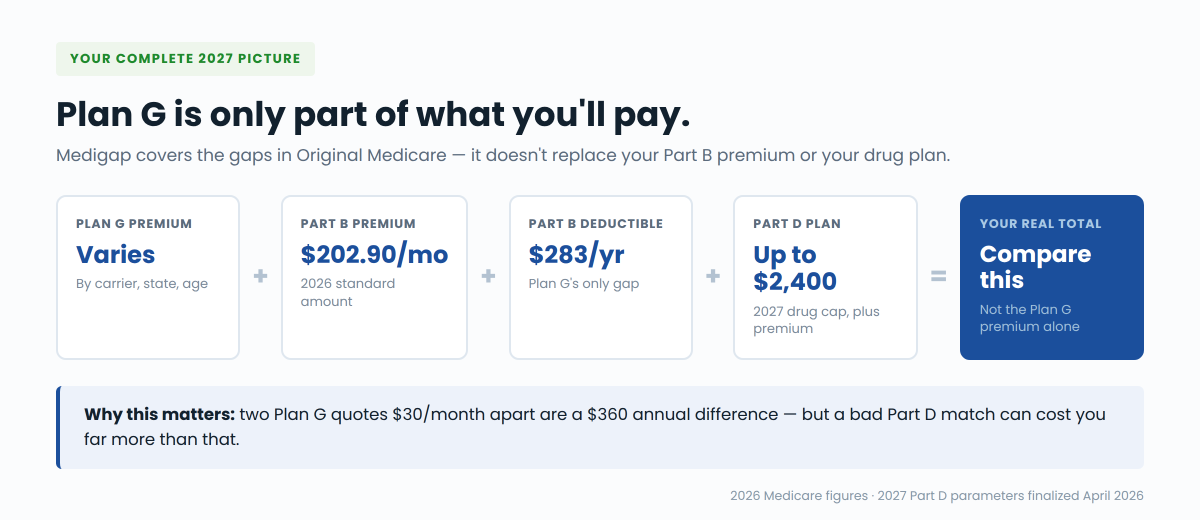
What You Actually Pay With Plan G

Three things, and only one of them is a claim cost:

The Part B deductible — $283 in 2026. Once per calendar year. After you’ve met it, Medicare-approved services cost you nothing out of pocket.

Your Plan G premium. Set by the carrier, filed by state, and varying with your age and in most states tobacco use. This is the number that differs between companies.

Your Medicare Part B premium — $202.90 per month in 2026. You pay this regardless of whether you carry Medigap at all.

What Plan G does not include is prescription drug coverage. You’ll need a separate Part D plan, and for 2027 that plan carries a $2,400 annual out-of-pocket cap with a $700 standard deductible.

Standard Plan G vs High-Deductible Plan G

Standard Plan G vs high deductible Plan G in 2027

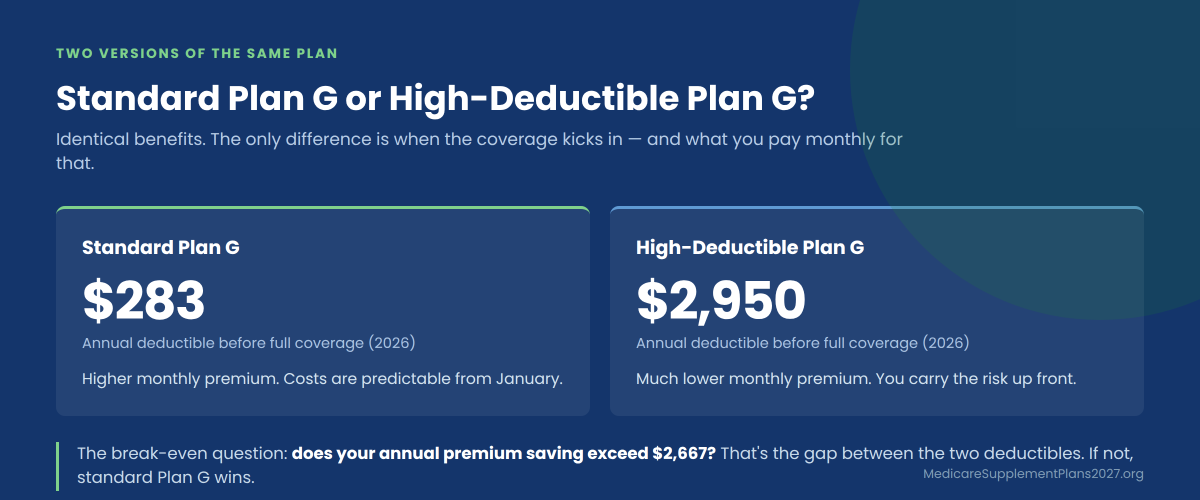
Both plans cover exactly the same benefits. The difference is when coverage begins and what you pay monthly for the privilege.


Factor Standard Plan G High-Deductible Plan G
Annual deductible (2026) $283 $2,950
Monthly premium Higher Substantially lower
Benefits covered Identical Identical
Best suited to Predictable budgeting, frequent care Healthy years, tolerance for upfront risk

The break-even calculation is simple: the deductible gap between the two is $2,667. If switching to the high-deductible version saves you more than that in annual premium, it wins mathematically. If it doesn’t, Standard Plan G is the better buy — and it’s the better buy in any year you actually need care.

Plan G vs Plan N for 2027

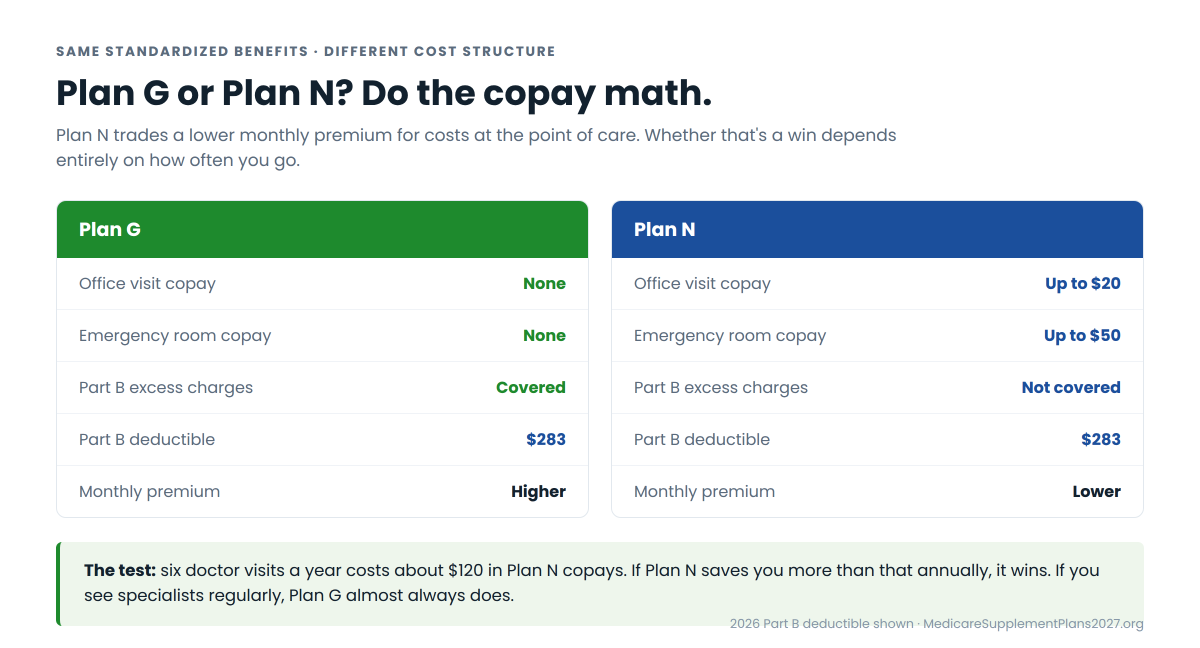
Plan G vs Plan N 2027: Plan G has no office visit or emergency room copays and covers Part B excess charges, while Plan N charges up to $20 per office visit and $50 per ER visit at a lower monthly premium

Medicare Plan N in 2027 is the main alternative people weigh against Plan G. It costs less monthly and asks more of you at the point of care.

Factor Plan G Plan N
Office visit copay None Up to $20
Emergency room copay None Up to $50
Part B excess charges Covered Not covered
Monthly premium Higher Lower
Part B deductible You pay $283 You pay $283


Run the arithmetic on your own usage. If you see doctors six times a year, Plan N’s copays cost you about $120 — so Plan N wins only if it saves you more than that annually.

If you’re in and out of specialists, Plan G almost always wins.

One underrated factor: Plan N doesn’t cover Part B excess charges. Most providers accept Medicare assignment and never bill them, but in a handful of states they’re more common.

Check your state before treating that line as theoretical.

What Plan G Costs in 2027

Compare Medicare Plan G costs for 2027

Medicare Plan G premiums are filed carrier by carrier and state by state. They vary with your age, your ZIP code, and, in most states, whether you use tobacco. There is no national price, and any site quoting one is generalizing past the point of usefulness.

What you can control is how you compare. Since every Plan G covers identical benefits, a price difference between two carriers is pure savings — there’s no coverage trade-off hiding behind it.

Compare Plan G to Plan G only. Same letter, same coverage, different price. That’s the entire exercise.

Ask about rate increase history. The cheapest first-year premium is frequently not the cheapest fifth-year premium.

Add your Part D plan to the total. A poor drug-plan match can cost more than the entire premium difference between two Plan G carriers.

How Plan G Rates Increase Over Time

This is the part most comparison sites skip, and it matters more than the first-year premium.

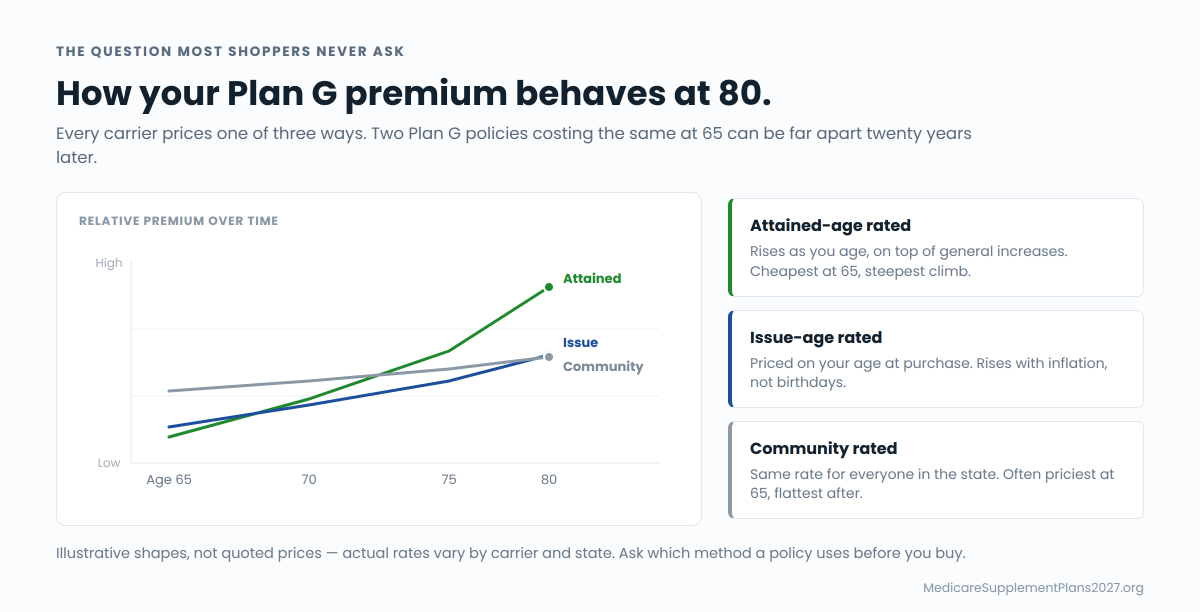
Carriers use one of three pricing methods, and which one your policy uses determines how your premium behaves for the next twenty years:

Attained-age rated. Premium rises as you get older, on top of general rate increases. Usually the cheapest at 65 and the most expensive at 80. The most common method.

Issue-age rated. Priced on the age you were when you bought it. It still rises with inflation and claims, but not because you had a birthday.

Community rated. Everyone in the state pays the same rate regardless of age. Often the most expensive at 65 and the most stable later.

Ask which method a carrier uses before you buy. Two Plan G policies at the same price today can be hundreds of dollars apart per month by the time you’re 80.

Medicare Plan G rate increases over time

When to Enroll in Plan G

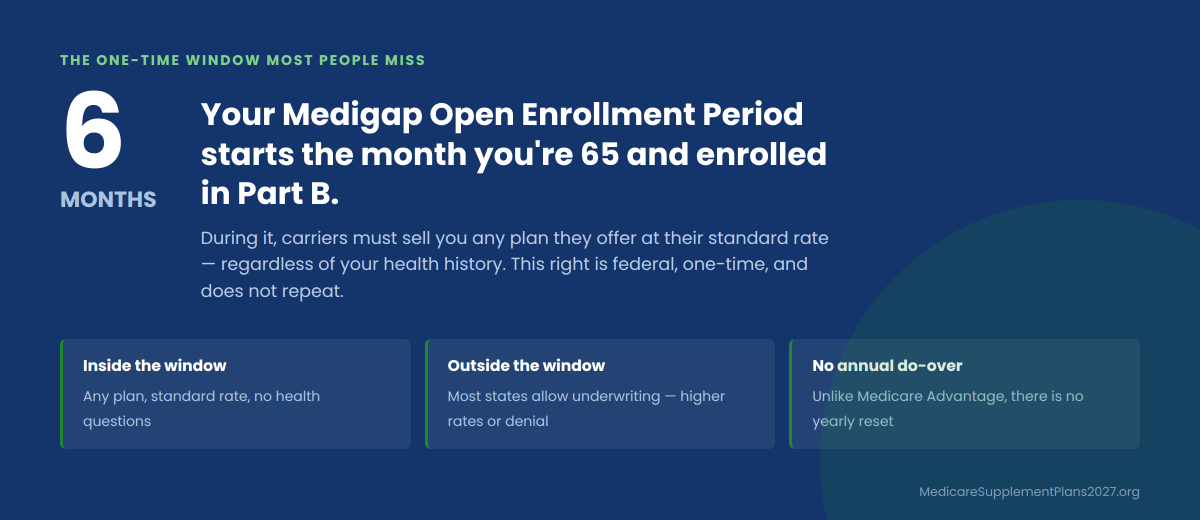
Your Medigap Open Enrollment Period is six months long, beginning the month you’re 65 or older and enrolled in Medicare Part B. During it, carriers must sell you Plan G at their standard rate regardless of your health history.

That protection is federal, one-time, and does not repeat. Outside it, most states allow carriers to medically underwrite — meaning they can charge more or decline you entirely.

  • Guaranteed issue rights can open outside that window — losing employer coverage, a plan exiting your area, or a carrier misrepresenting a policy.
  • A few states are more generous. Some allow annual changes without underwriting. Check your own state rather than the national default.
  • There’s no annual Medigap enrollment period. Unlike Medicare Advantage, you don’t get a yearly do-over by default.

Enter your ZIP code above to compare 2027 Plan G rates from carriers licensed in your state.
medigap-open-enrollment-window

Medicare Supplement Plan G 2027 — Frequently Asked Questions

➤ What does Medicare Supplement Plan G cover?

Plan G covers the Part A hospital deductible, Part A and Part B coinsurance, Part B excess charges, skilled nursing facility coinsurance, the first three pints of blood, hospice coinsurance, and 80% of foreign travel emergency care to plan limits. The only Medicare cost it doesn’t cover is the annual Part B deductible, which was $283 in 2026. It does not include prescription drug coverage.

➤ How much does Plan G cost in 2027?

Plan G premiums are filed by carrier and by state, and vary with your age, ZIP code and in most states tobacco use. There is no single national price. Because benefits are federally standardized, a Plan G quote from one carrier is directly comparable to a Plan G quote from another, so price differences are pure savings. Compare quotes for your own ZIP code to know your actual cost.

➤ What is the Plan G deductible for 2027?

Standard Plan G leaves you responsible for the annual Medicare Part B deductible, which was $283 in 2026. High-Deductible Plan G carries a separate plan deductible of $2,950 in 2026 before coverage begins. The 2027 amounts are announced in the fall, but the structure stays the same — only the dollar figures change.

➤ Is Plan G better than Plan N?

It depends on how often you use care. Plan G has no office visit or emergency room copays and covers Part B excess charges; Plan N charges up to $20 per office visit and up to $50 per emergency room visit, and doesn’t cover excess charges. Plan N’s premium is lower. If your annual premium saving on Plan N exceeds what you’d spend on copays, Plan N wins — otherwise Plan G does.

➤ Is high-deductible Plan G worth it?

The benefits are identical to standard Plan G — only the deductible and premium differ. The 2026 gap between the two deductibles is $2,667, so high-deductible Plan G makes mathematical sense only if it saves you more than that in annual premium. It suits people in good health with the cash reserves to absorb a bad year, and it’s the wrong choice in any year you need significant care.

➤ Does Plan G cover prescription drugs?

No. Medicare Supplement plans sold today do not include prescription drug coverage, so Plan G enrollees need a separate Part D plan. For 2027 the Part D annual out-of-pocket cap is $2,400, up from $2,100 in 2026, and the standard deductible is $700, up from $615. Budget for your Plan G premium and your Part D costs together.

➤ Is Plan G the same with every insurance company?

Yes. Medigap benefits are standardized by federal law, so Plan G covers exactly the same services no matter which carrier sells it. Carriers compete on price, rate stability and customer service rather than coverage. Massachusetts, Minnesota and Wisconsin standardize their plans differently, so the letter system works differently in those three states.

➤ Why do Plan G premiums increase every year?

Rates rise with medical inflation and claims experience, and how much depends on the carrier’s pricing method. Attained-age policies also increase as you get older, on top of general increases. Issue-age policies are priced on your age at purchase and don’t rise with birthdays. Community-rated policies charge everyone in the state the same. Ask which method applies before you buy — it can mean hundreds of dollars a month by age 80.

➤ When can I enroll in Plan G?

Your Medigap Open Enrollment Period lasts six months, beginning the month you’re 65 or older and enrolled in Medicare Part B. During that window carriers must sell you Plan G at their standard rate regardless of your health. This right is one-time and does not repeat. Outside it, most states allow medical underwriting, meaning a carrier can charge more or decline coverage based on your health history.

➤ Can I switch to Plan G later?

You can apply at any time, but outside your Medigap Open Enrollment Period or a guaranteed issue situation, most states allow the carrier to medically underwrite your application — meaning they can charge more or decline you. A few states have more generous rules permitting changes without underwriting, so check your state specifically rather than assuming the national default.

➤ Can I get Plan F instead of Plan G?

Only if you became eligible for Medicare before January 1, 2020. Plan F and Plan C were closed to newly eligible beneficiaries as of that date, which is why Plan G is now the most comprehensive option for most people. Plan G covers everything Plan F did except the Part B deductible, and it isn’t in a closed risk pool — closed pools tend to see steeper rate increases over time.

View plans & rates in your zip code

Speak with a licensed insurance agent

1-855-409-6195TTY 711

Mon-Fri: 8am-9pm ET

Have Questions?

Speak with a licensed insurance agent

1-855-409-6195

TTY users 711

Mon-Fri: 8am-9pm ET

Compare plans & benefits in your area

Or speak with a licensed insurance agent

1-855-409-6195TTY 711

Mon-Fri: 8am-9pm ET